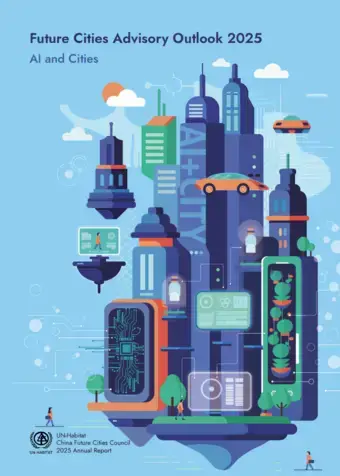
Future Cities Advisory Outlook 2025: AI and Cities
By 2050, an additional 2.3 billion people will reside in cities, which equivalent to the entire global population of 1950. This rapid expansion places unimaginable pressure on housing, transportation, and energy, largely due to the systemic inefficiencies of traditional urbanization. At its heart, the Future Cities Advisory Outlook 2025: AI and Cities confronts one singular, ambitious question: Can 10% of a city’s current resources support its sustainable, high-quality development? By shifting the focus from resource consumption to intelligent optimization, this report argues that radical efficiency is the only viable path forward.
To address this challenge, the report systematically explores how AI is driving a revolution in global development models. It draws extensively on China’s "City Brain" practices, demonstrating how the integration of data, models, and computing power can transition urban governance from fragmented silos to holistic, synergistic systems. These practices adopt a people-centred approach, focusing on scenario-based services that break down departmental barriers. By synthesizing these experiences, the report provides a technical panorama across six key urban domains and establishes a definitive four-phase roadmap to guide digital transformation.
Beyond theoretical frameworks, the report offers a practical toolkit featuring twelve in-depth case studies from Chinese local governments and technology institutions. These examples provide a real-world look at how resource efficiency is achieved through intelligent sharing. Concluding with strategic recommendations and the "AI + City" Global Collaboration Initiatives, it invites stakeholders to move beyond traditional growth constraints and pursue a new civilization paradigm—Less is more for better life.
 Поделиться