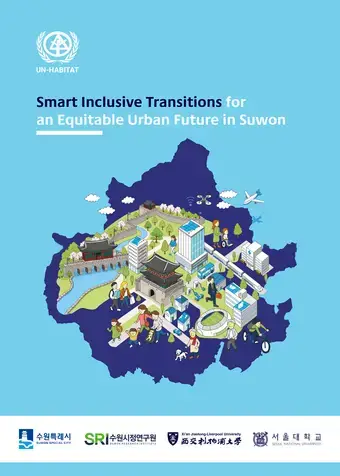
Smart Inclusive Transitions for an Equitable Urban Future in Suwon
This report demonstrates how a city can use urban SDGs-based monitoring to harness technological innovation while remaining inclusive, sustainable and responsive to all residents. Applying the Smart Inclusive Transition (SIT) framework with the Global Urban Monitoring Framework, the report diagnoses the city across five SIT pillars: infrastructure and essential services; urban management through co-production; social justice for vulnerable residents; digital innovation; and sustainable production and consumption.
The SIT analysis combines internationally comparable indicators with policy review, citizen and expert perspectives, and three demonstration cases – co-producing adequate housing, demand-responsive transport, and an intermediary urban innovation platform. It assesses the city’s relative performance across the five pillars, identifying key strengths, inequalities, and areas requiring policy attention, while the demonstration cases show how SIT principles can be operationalized in practice.
The findings show that the city has developed strong digital infrastructure, capable public institutions and established mechanisms for citizen collaboration, yet these assets are not everywhere translating into equitable outcomes. The central challenge – and opportunity – is to use existing digital and institutional capacity more effectively to diversify participation, target disparities, and support environmental transition. This requires closer alignment between technology, governance and the needs of groups that are currently less well served.
As the first comprehensive citywide SIT assessment, this publication offers policy pathways and a transferable reference for other cities. It shows how global monitoring frameworks can be localized, how indicators can be interpreted alongside lived experience, and how smart-city strategies can advance the Sustainable Development Goals, inclusion and urban resilience.
 Share
Share