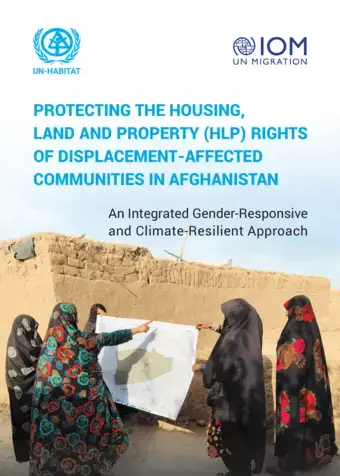
Protecting the Housing, Land, and Property (HLP) Rights of Displacement-affected Communities in Afghanistan
Afghanistan faces complex displacement and reintegration challenges. Decades of conflict have resulted in a legacy of 6 million Internally Displaced People (IDPs), while an emerging post-conflict trend has seen a surge in cross-border returns – between 600,000 and 1.5 million people have been forcibly returned to Afghanistan since 2023. In this context, Afghanistan’s informal settlements are emerging as key sites of displacement, hosting large populations of both protracted IDPs and recent returnees.
Residents of informal settlement face severe HLP risks, including growing threats of eviction, which have limited investments in housing, critical infrastructure and services. Afghanistan’s climate breakdown exacerbates these challenges, exposing vulnerable residents to floods, droughts and associated disease. Women are disproportionately affected due to their roles in domestic labor and childcare, which increase during times of climate shocks. Strengthening HLP rights in such areas underpin investments in gender-sensitive, climate-resilient housing and community infrastructure, and are prerequisite to sustainable reintegration of displaced populations residing in informal settlements.
In response to these challenges, the International Organization for Migration (IOM) engaged UN-Habitat to implement a research and capacity-building project aimed at advancing sustainable solutions for displacement-affected communities in Afghanistan. Beginning in 2023, the Housing Land and Property (HLP) Rights of Displacement-affected Communities in Afghanistan project promotes data-driven, gender-responsive, and climate-resilient HLP programming. Focusing on six informal settlements in Jalalabad and Herat—key sites of internal displacement and hubs for returnees from Pakistan and Iran, respectively—the project addressed HLP insecurity, climate vulnerability, and gender inequality through an integrated HLP and climate resilience programmatic approach. Read more...
UN-Habitat Lebanon Unions of Municipalities' COVID-19 Rapid Assessment Report
From the onset of the COVID-19 pandemic in Lebanon, local authorities have been playing a major role to curtail the spread of the disease, particularly in vulnerable urban settings, while still maintaining critical services.
To identify major problems and suggest solutions, UN-Habitat assessed 34 Unions of Municipalities, in addition to 5 individual municipalities, covering 52 per cent of all municipalities in Lebanon, which translated into more than 3 million Lebanese nationals, 700,000 Syrian refugees, and 180,000 Palestinian refugees from Lebanon.
The report highlights several key urban challenges relating to COVID-19 such as lack of clean water in most disadvantaged urban neighbourhoods and the incorrect treatment of wastewater and solid medical waste. Other challenges include translating national level directives and guidance at the local level and a lack of clear procedures on preventative measures to take against COVID-19 at the community level.
The report also proposes a number of mitigating measures ranging from the most urgent to long-term needs to promptly and effectively address the challenges of COVID-19 at the urban level led by local authorities.
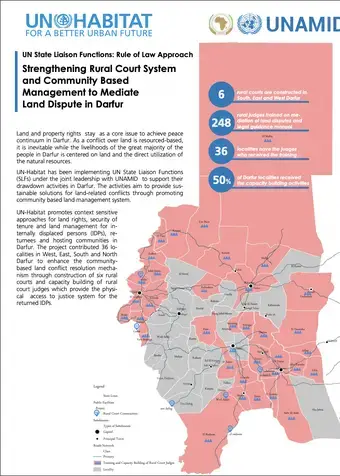
Strengthening Rural Court System and Community Based Management to Mediate Land Dispute in Darfur
State Liaison Functions (SLF) is an integrated mechanism aims to provide a bridge from peace keeping activities to peacebuilding activities in Darfur within the drawdown of UNAMID. It has started in January 2019 within joint leadership with UNAMID and UNCT in close cooperation with national actors. Under the pillar of rule of law, UN-Habitat developed the capacity of the rural courts to address conflict over lands and natural resources.
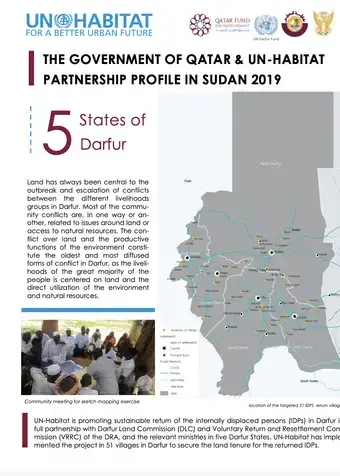
The Government of Qatar & UN-Habitat Partnership Profile in Sudan 2019
Securing land tenure is the fundamental right of every individual. It is particularly important for the vulnerable groups including female-headed households. The project “Strengthening Land Management for Peaceful Co-Existence in Darfur” (2015-2018) was designed to improve current land title system in Darfur and to contributes in the development of evidence-based land policies, laws and regulations.
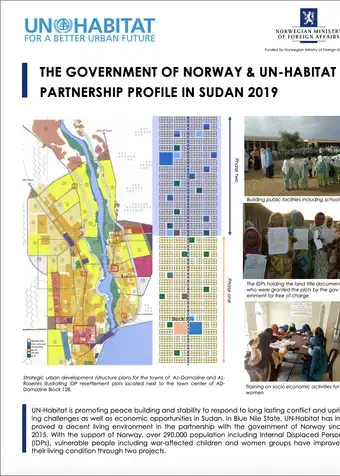
The Government of Norway & UN-Habitat Partnership Profile in Sudan 2019
The 4-page brochure showcases the two projects in Blue Nile funded by the Government of Norway: “Promote Peace building and Stability in the Blue Nile” (2016-2019), and “Strategic Urban Development/Structure Plans for the Towns of Ad-Damazine and Al-Roseiris” (2015-2016) with the project outlines, achievements, and voices from the beneficiaries.
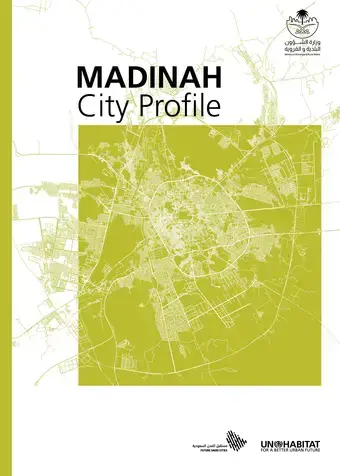
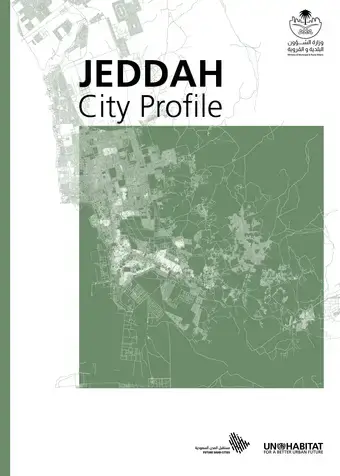
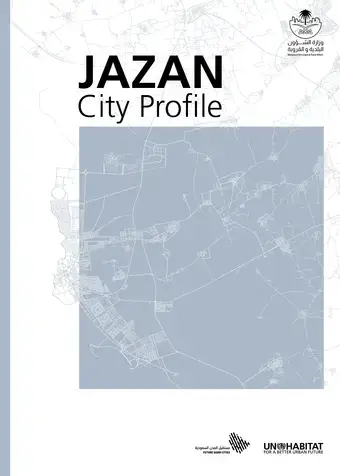
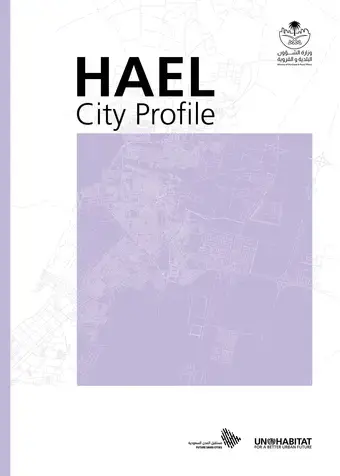
The Future Saudi Cities Programme is a joint programme developed by the Ministry of Municipal and Rural Affairs in Saudi Arabia and UN-Habitat, implemented in close cooperation with the municipalities of 17 major Saudi cities, the cities have been selected based on their different population sizes, geographic distribution, and a range of criteria based on capacities and economic potential to create a more balanced regional development among the cities of Saudi Arabia. The chosen cities include Riyadh, Makkah, Jeddah, Taif, Madinah, Tabuk, Dammam, Qatif, Al-Ahsa, Abha, Najran, Jazan, Hael, Arar, AlBaha, Buraidah, and Skaka. one of FSCP outcomes is the city profiles.
The city-profile performs as a thinking tool that constitutes together an assessment tool and guidance for the current and future planning of the city, whilst defining a clear strategy for sustainable development. This tool is based on the UN-Habitat’s three-pronged approach considers spatial planning in relation to legal and institutional frameworks, in addition to financial mechanisms. In this way, success criteria for the sustainable implementation of a spatial plan should include flexible but enforceable rules and regulations, in addition to a financing strategy and projections.
The City Profile Methodology, that is applied to Tabuk, is contenting the following steps:
1- Evidence based input approach.
2- The City reviews.
3- The City Prosperity Index assessment report.
4- The GIS spatial analysis.
The Future Saudi Cities Programme is a joint programme developed by the Ministry of Municipal and Rural Affairs in Saudi Arabia and UN-Habitat, implemented in close cooperation with the municipalities of 17 major Saudi cities, the cities have been selected based on their different population sizes, geographic distribution, and a range of criteria based on capacities and economic potential to create a more balanced regional development among the cities of Saudi Arabia. The chosen cities include Riyadh, Makkah, Jeddah, Taif, Madinah, Tabuk, Dammam, Qatif, Al-Ahsa, Abha, Najran, Jazan, Hael, Arar, AlBaha, Buraidah, and Skaka. one of FSCP outcomes is the city profiles.
The city-profile performs as a thinking tool that constitutes together an assessment tool and guidance for the current and future planning of the city, whilst defining a clear strategy for sustainable development. This tool is based on the UN-Habitat’s three-pronged approach considers spatial planning in relation to legal and institutional frameworks, in addition to financial mechanisms. In this way, success criteria for the sustainable implementation of a spatial plan should include flexible but enforceable rules and regulations, in addition to a financing strategy and projections.
The City Profile Methodology, that is applied to Tabuk, is contenting the following steps:
1- Evidence based input approach.
2- The City reviews.
3- The City Prosperity Index assessment report.
4- The GIS spatial analysis.
The Future Saudi Cities Programme is a joint programme developed by the Ministry of Municipal and Rural Affairs in Saudi Arabia and UN-Habitat, implemented in close cooperation with the municipalities of 17 major Saudi cities, the cities have been selected based on their different population sizes, geographic distribution, and a range of criteria based on capacities and economic potential to create a more balanced regional development among the cities of Saudi Arabia. The chosen cities include Riyadh, Makkah, Jeddah, Taif, Madinah, Tabuk, Dammam, Qatif, Al-Ahsa, Abha, Najran, Jazan, Hael, Arar, AlBaha, Buraidah, and Skaka. one of FSCP outcomes is the city profiles.
The city-profile performs as a thinking tool that constitutes together an assessment tool and guidance for the current and future planning of the city, whilst defining a clear strategy for sustainable development. This tool is based on the UN-Habitat’s three-pronged approach considers spatial planning in relation to legal and institutional frameworks, in addition to financial mechanisms. In this way, success criteria for the sustainable implementation of a spatial plan should include flexible but enforceable rules and regulations, in addition to a financing strategy and projections.
The City Profile Methodology, that is applied to Tabuk, is contenting the following steps:
1- Evidence based input approach.
2- The City reviews.
3- The City Prosperity Index assessment report.
4- The GIS spatial analysis.
The Future Saudi Cities Programme is a joint programme developed by the Ministry of Municipal and Rural Affairs in Saudi Arabia and UN-Habitat, implemented in close cooperation with the municipalities of 17 major Saudi cities, the cities have been selected based on their different population sizes, geographic distribution, and a range of criteria based on capacities and economic potential to create a more balanced regional development among the cities of Saudi Arabia. The chosen cities include Riyadh, Makkah, Jeddah, Taif, Madinah, Tabuk, Dammam, Qatif, Al-Ahsa, Abha, Najran, Jazan, Hael, Arar, AlBaha, Buraidah, and Skaka. one of FSCP outcomes is the city profiles.
The city-profile performs as a thinking tool that constitutes together an assessment tool and guidance for the current and future planning of the city, whilst defining a clear strategy for sustainable development. This tool is based on the UN-Habitat’s three-pronged approach considers spatial planning in relation to legal and institutional frameworks, in addition to financial mechanisms. In this way, success criteria for the sustainable implementation of a spatial plan should include flexible but enforceable rules and regulations, in addition to a financing strategy and projections.
The City Profile Methodology, that is applied to Tabuk, is contenting the following steps:
1- Evidence based input approach.
2- The City reviews.
3- The City Prosperity Index assessment report.
4- The GIS spatial analysis.
The Future Saudi Cities Programme is a joint programme developed by the Ministry of Municipal and Rural Affairs in Saudi Arabia and UN-Habitat, implemented in close cooperation with the municipalities of 17 major Saudi cities, the cities have been selected based on their different population sizes, geographic distribution, and a range of criteria based on capacities and economic potential to create a more balanced regional development among the cities of Saudi Arabia. The chosen cities include Riyadh, Makkah, Jeddah, Taif, Madinah, Tabuk, Dammam, Qatif, Al-Ahsa, Abha, Najran, Jazan, Hael, Arar, AlBaha, Buraidah, and Skaka. one of FSCP outcomes is the city profiles.
The city-profile performs as a thinking tool that constitutes together an assessment tool and guidance for the current and future planning of the city, whilst defining a clear strategy for sustainable development. This tool is based on the UN-Habitat’s three-pronged approach considers spatial planning in relation to legal and institutional frameworks, in addition to financial mechanisms. In this way, success criteria for the sustainable implementation of a spatial plan should include flexible but enforceable rules and regulations, in addition to a financing strategy and projections.
The City Profile Methodology, that is applied to Tabuk, is contenting the following steps:
1- Evidence based input approach.
2- The City reviews.
3- The City Prosperity Index assessment report.
4- The GIS spatial analysis.
 Share
Share