People Centred-Smart Cities
Summary
People-centered Smart Cities enhances shared prosperity of cities and regions by making urban digital transformation work for the benefit of all, driving sustainability, inclusivity and prosperity and the realization of human rights. Together with the other flagship programmes and in collaboration with other United Nations agencies, as well as State and non-State actors, this flagship is expected to achieve:
- digital policy transformation
- financing digital urban innovation
- digital empowerment and capacity building.
Challenges addressed
Today, while more than 50 per cent of the world’s population is online, there are still 3.6 billion people without affordable access to the internet. This severely restricts the ability of cities to ensure an even digital transformation of society. There is a strong inequality component to this challenge: among the world’s 47 least-developed countries, more than 80 per cent of the population is still offline, and the gender gap in connectivity continues to widen, excluding women further from participation at all levels and in being counted and considered in important urban decisions. The COVID-19 pandemic exposed the inequalities underpinning the digital divide at global and local scales. Many households, schools and neighbourhoods are not able to access remote education, telemedicine and teleworking due to weak, absent or unaffordable internet connectivity or lack of computers. Cities are increasingly relying on digital technologies and connectivity to sustain operations and deliver services, while not all residents have access to these tools and are further marginalized. Residents of slums and other marginalized and deprived neighbourhoods and communities in cities may face higher gaps in digital literacy and access to the internet, particularly women.
The full potential of the urban digital transformation and the ‘smart city’ to contribute to the SDGs has in many cases not yet been realized. A lack of digital technology skills in local governments, missing digital governance frameworks, overreliance on private sector innovation, not enough consideration of the impact of digital technologies on human rights and the persistent digital divide are challenges that need to be overcome. The UN System-wide Strategy on Sustainable Urban Development highlights digital transformation and new technologies as one of the four frontier issues that require a special, coordinated response. UN-Habitat is working to set a new people-centered direction for smart cities.
UN-Habitat is taking an active role in coordinating the field and working towards setting a new smart city approach that favours inclusive, resilient and sustainable use of technologies by local government1 . Collaboration frameworks relating to smart cities and digital transfor-mation of cities and communities have been signed with the International Telecommunication Union and UNDP.
Quote
Secretary-General remarks
Digital technologies, depending on their use, can be a force that widens social gaps or reduces them. Recognizing the ever-increasing digital gap, the Secretary General sounded one of his top five alarm bells for 2022 as “going into emergency mode to put humanity at the centre of technology,” and is pursuing every opportunity to “help close the digital divide, and ensure affordable, safe and secure internet services for all.”
What UN-Habitat can offer
- Technical advice and guidance to local, regional and national governments on putting people at the centre of their digital transformation and smart city strategies based on the 2021 guidance note Putting People at the Centre of Smart Cities.
- Technical advice and guidance to local, regional and national governments on assessing and addressing the urban digital divide based on guidance in the 2021 playbooks Assessing the Urban Digital Divide and Addressing the Urban Digital Divide.
- Technical advice and guidance to local and regional governments on setting up effective data platforms and systems, including people-centered and inclusive data governance frameworks, strategies, and policies.
- Technical advice to local governments on issues related to digital human rights, digital inclusion, and digital governance as part of a collaboration with the Cities for Digital Rights Coalition, United Cities and Local Governments and Eurocities.
- Capacity building for cities and local governments on key issues related to people-centered smart city strategies, inclusive data systems and platforms, digital human rights, assessing and addressing the digital divide and digital public participation.
- Challenge definition workshops with cities who want to take a people-centric, needs-driven, and challenge-based approach to procuring and implementing appropriate digital services and technologies.
It is critical that smart city planning focuses on solving specific sustainability problems and key missions such as battling climate change, reducing poverty and increasing citizens’ participation rather than following a technocratic industry-driven approach. The flagship expects to achieve the following outcomes:
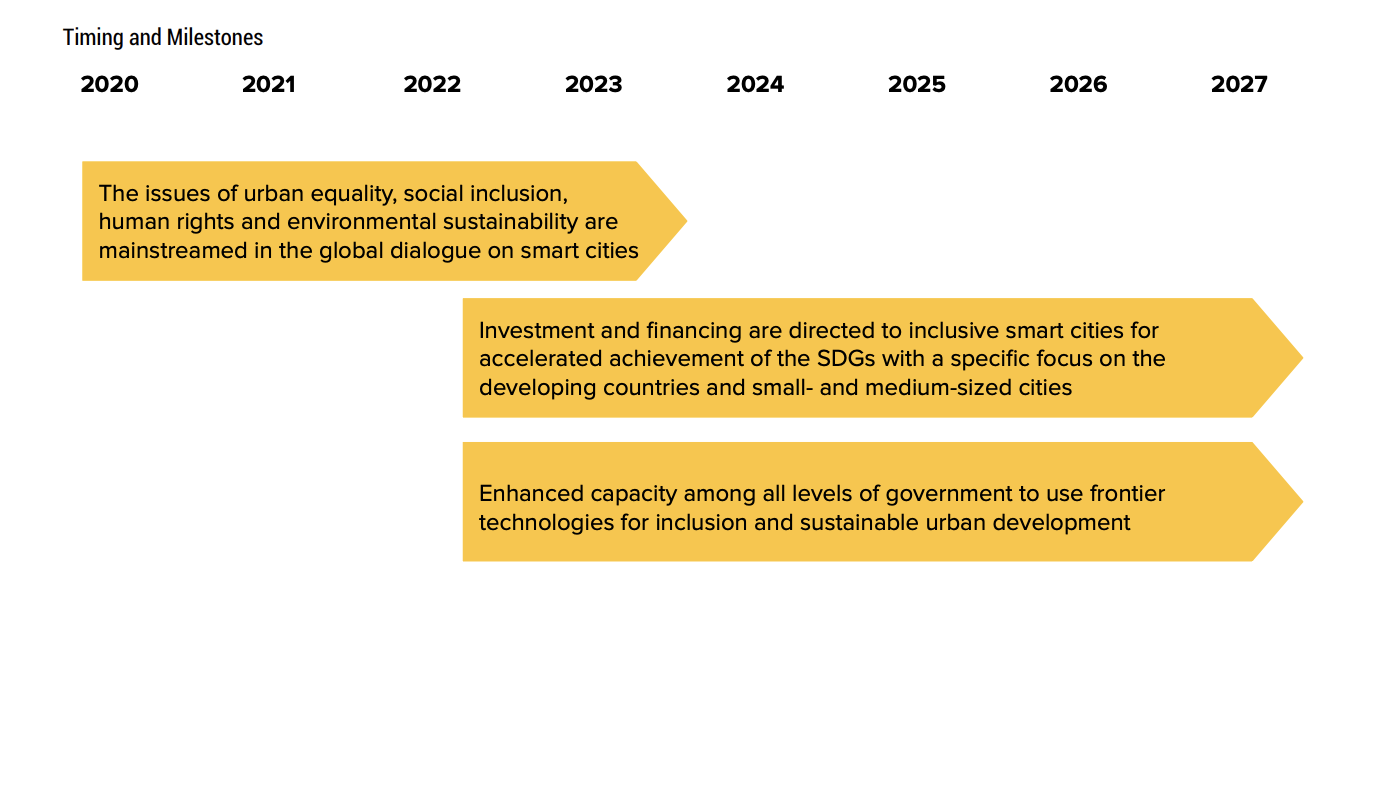
- Digital policy transformation: Increased focus and mainstreaming of people-centered, sustainable and inclusive digital transition as a critical policy topic in high-level political forums and global dialogues on smart cities.
- Financing digital urban innovation: Increased investment and financing for people-centered smart cities to accelerate the achievement of the SDGs with a specific focus on developing countries, smalland medium-sized cities and grassroots urban communities
- Digital empowerment and capacity building: Enhanced capacity of governments at all levels to adopt a peoplecentered, privacy-enhancing and rights-preserving approach to digital technologies for inclusion and sustainable urban development in the achievement of the SDGs.
Duration of support
This flagship programme is intended to provide support to national and local governments in close collaboration with the private sector, civil society, academia and communities for at least eight years under an overall umbrella which will include a variety of pilot projects, coordination mechanisms, policy and normative tools, technical advisory services and the financing facility
Timing and Milestones
Related SDGs