Download
BASF Website
Share
Number of pages
149
Publication date
2014

Evaluation of BASF Stiftung UN-Habitat Programme Contribution Towards Sustainable Development, December 2014

The BASF Stiftung and UN-Habitat partnership was established in 2005. Its major thrust is the (i) exchange of best practices; (ii) sustainable reconstruction projects for disaster areas; and (iii) dissemination of information and application of environmental technologies. Since the inception of this partnership, BASF Stiftung has funded 19 projects with a total value of USD 4,217,309. But the actual value of these projects may be higher, taking into account the many additional in-kind contributions of local beneficiary communities, local project partners, and UN-Habitat. Apart from these additional contributions (cash and in-kind), the evaluation found that all projects have generated great enthusiasm and interest by a large diversity of stakeholders.

Download
Changed page
Share
Number of pages
69
Publication date
2016

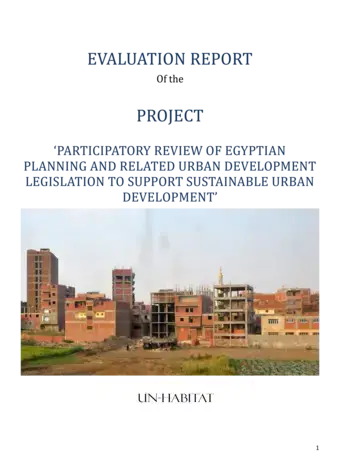
Evaluation of Participatory Review of Egyptian Planning and Related Urban Development Legislation to Support Sustainable Urban Development, April 2016

The evaluated project was an innovative intervention that touched upon a topic that had not been addressed before. It made use of a participatory method that involved intensive engagement with stakeholders at different levels and managed to produce processes and patterns that can be replicated in the future. It also managed to highlight important problems and identify their root causes, while it also allowed the exchange of experiences at regional level. The project was highly relevant to the needs of Egypt and the stakeholders and was implemented in an expeditious and efficient manner, on time and within budget. As a pilot, the present project generated valuable lessons to guide future activities dealing with legislation in Egypt and beyond.

European Union (EDF), Mid-Term Evaluation of the Participatory Slum Upgrading Programme II (PSUP II), August 2015

The Participatory Slum Upgrading Programme II (PSUP II) is an initiative of the African, Caribbean and Pacific (ACP) Secretariat, financed by the European Commission (EC) under the Tenth European Development Fund (10th EDF), and implemented by the United Nations Human Settlements Programme (UN-Habitat). Started on 1st January 2012 with a planned Implementation period of 48 months ending on 31st December 2015, PSUP II is a consolidation and extension of the 9th EDF PSUP I that was launched in 30 ACP countries in February 2008 and ended in December 2011. The Programme has since expanded to 35 countries, involving more than 86 cities. The overall goal of PSUP II is to improve the living conditions of the urban poor and contribute to Millennium Development Goal (MDG) 7, to ‘ensure environmental sustainability’; and, more specifically, Target 7C (halve the proportion of people without sustainable access to safe drinking water and basic sanitation by 2015) and Target 7D (significantly improve the lives of at least 100 million slum dwellers by 2020). In order to achieve this goal, the project purpose is to strengthen local, national and regional decisionmakers, institutional and key urban stakeholders' capacities in slum improvement and prevention by enabling them to identify appropriate responses to increased urbanisation of poverty and to efficiently implement propoor urban policies, city-wide slum upgrading strategies and slum upgrading demonstration projects following an approach of three phases.

Download
UrbanLedsProject
Share
Number of pages
82
Publication date
2015

Interim Evaluation of the Urban LEDS Project, Synthesis Report, September 2015

The Urban-LEDS Project “Promoting Low Emission Urban Development Strategies in Emerging Economy Countries” (the Project) was initiated in partnership between United Nations Human Settlements Programme (UN-Habitat) and ICLEI – Local Government for Sustainability to support low emissions development and address climate change, funded by the European Commission (EC).

ICLEI has the principal project implementation responsibilities working through its ICLEI country offices. ICLEI implemented the project in four countries (Brazil, India, Indonesia and South Africa). In each of those countries the team worked with two Model Cities that received intensive assistance, as well as between four and six Satellite Cities that engaged to a lesser degree.

A handful of European cities served as resource cities. The team implemented the project through a set of seven “Work Packages”. UN-Habitat has administrative responsibilities and participated in focused technical activities providing project support. The Objective of the Project is “to enhance the transition to low emission urban development in emerging economy countries.”

This is to be accomplished through the preparation of LED strategies in Model Cities and where possible in Satellite Cities through capacity building, city-to-city exchanges, hands on actions including emissions inventories to identify priority areas for interventions, and to understand, assess, design and implement LED technical and behavior change action activities in target cities. The total Project budget provided by the EC is6,700,000.00 Euros for a 42 month period from March 2012 to August 2015.

Evaluation of the Municipal Spatial Planning Support Programme MuSPP Phase 3, July 2014

MusPPThis evaluation was carried out during the third phase of the Municipal Spatial Planning Support Programme (MuSPP). The programme as a whole started 8 years ago in 2005 and phase 3 in 2011.

The intention is to assess the progress towards project objectives, to look beyond the current project and to give the opportunity to adjust the work of the final months so as to maximize the sustainability of impact.

Share