Download
UN-Habitat Housing Initiatives in Afghanistan | Selected Projects
Share
Number of pages
14
Publisher
UN-Habitat Afghanistan

UN-Habitat Housing Initiatives in Afghanistan | Selected Projects

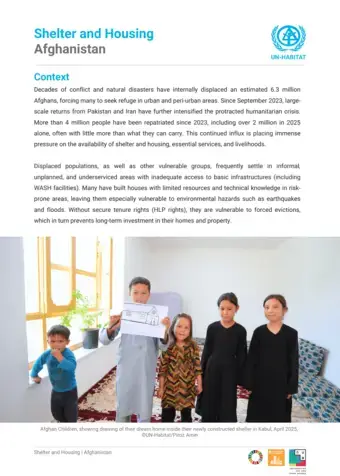
Decades of conflict and natural disasters have internally displaced an estimated 6.3 million Afghans, forcing many to seek refuge in urban and peri-urban areas. Since September 2023, large-scale returns from Pakistan and Iran have further intensified the protracted humanitarian crisis. More than 4 million people have been repatriated since 2023, including over 2 million in 2025 alone, often with little more than what they can carry. This continued influx is placing immense pressure on the availability of shelter and housing, essential services, and livelihoods.

Displaced populations, as well as other vulnerable groups, frequently settle in informal, unplanned, and underserviced areas with inadequate access to basic infrastructures (including WASH facilities). Many have built houses with limited resources and technical knowledge in risk-prone areas, leaving them especially vulnerable to environmental hazards such as earthquakes and floods. Without secure tenure rights (HLP rights), they are vulnerable to forced evictions, which in turn prevents long-term investment in their homes and property.
UN-Habitat has been at the forefront of addressing these shelter challenges, delivering life-saving assistance and enhancing living conditions, recognizing that adequate shelter and housing as well as HLP rights are central to the durable solutions strategy, enabling people to achieve self-reliance and resilience...

Mass housing requires mass housing finance - Marja Hoek Smit, Wharton School, University of Pennsylvania

In this lecture Marja Hoek Smit argues that housing finance is critical to solve the housing problem, increasing, as it does, the number of households that can afford to acquire a house in the formal market, which in turn will make large scale development of middle and lower middle income housing possible.

Share

Too Pressed To Wait - Jane Weru, Executive Director Akiba Mashinani Trust

Jane Weru, Executive Director of Akiba Mashinani Trust, in her lecture “Too Pressed To Wait” discusses the water and sanitation hygiene systems in informal settlements in Nairobi, and how they are causing a strain on both the physical and psychological health of people who live and work in these settlements, in particular women and girls.

Share

UN-Habitat trains managers from Asia-Pacific on housing policy and practice

Seoul, 24 March 2015—UN-Habitat in partnership with the International Urban Training Center (IUTC) and the Provincial Government of Gangwon, Republic of Korea, recently organized a training programme for senior managers and decision makers from 11 Asia-Pacific countries focusing on ‘Housing Policy & Practice for Sustainable Urban Development’.


Share
Download
DefisdesFinances
Share
Number of pages
55
Publication date
2015
Publisher
UN-Habitat

Défis des finances publiques locales en Afrique

Le présent rapport examine les défis fondamentaux à relever dans le financement desadministrations publiques locales, les principales sources de recettes des collectivitéslocales et l’expérience acquise dans la fourniture de services durables. Il étudie égalementles systèmes et pratiques innovantes de gestion financière appliqués en Afrique.Cette analyse est complétée par une étude de cas consacrée à la ville de Gaborone(Botswana). Enfin, nous proposons certaines pistes pour l’amélioration des financeslocales sur le continent africain.

Download
Financing-Affordable-Housing-i
Share
Number of pages
62
Publication date
2008
Publisher
UN-Habitat

Financing Affordable Housing in Europe

This evaluation of social housing finance in Europe is placed in the context of the purpose of social housing, the sources of funds and the institutions that are used for provision. The effectiveness of social housing finance systems and the transferability of European approaches to other countries, particularly the developing world, are discussed. 

The analysis shows that an examination of the appropriate standards for decent housing and the barriers to market sector institutions meeting housing needs can usefully be investigated before alternative new institutions are created. If existing institutions are judged to be capable of delivery but financial incentives are inadequate, the focus should be on the best form of incentives. The use of a contractual form of provision is seen as a useful means of tying incentives to supply and potentially promoting good value for money.

It is argued that the European experience shows that housing finance that supports low income households is likely to involve a subsidy and that some form of subsidy and thus some form of transfer of resources into social housing will be needed if social housing is to have a social purpose that includes meeting housing needs as opposed to satisfying housing demand.

Post-industrial dynamics and urban housing - Hugo Priemus, Delft University of Technology

In his lecture on "Post-industrial dynamics and urban housing", Hugo Priemus advocates a mixed urban housing strategy to provide high-quality urban housing for knowledge workers and affordable housing for middle- and low-income households. 

Share

Urban Informality - Marginal or Mainstream? - Janice Perlman, The Megacities Project

In this lecture, Janice Perlman discusses urban informality against the background of 40 years of research in the favelas of Rio de Janeiro. The lecture lays particular emphasis on how the changes over this timespan have affected the lives of the people in the favelas. She concludes by introducing the Mega-Cities project strategy to 'shorten the lag time between ideas and implementation' in urban problem solving.

Share

Incremental Housing – The new site & services - Reinhard Goethert, Massachusetts Institute of Technology

Informal builders provide the bulk of affordable housing and define large areas of our cities. Originally created for those long considered as poor and unable to house themselves, over time the resultant informal housing generally matches higher income standards. This incremental process has been adopted by governments into programmes called 'site and services', focusing on housing and land development, and embracing process as the key. A methodology to capture this process has been developed which offers a base for developing effective policies in supporting the incremental builders.
Share
Download
Evaluation of the Experimental
Share
Number of pages
109
Publication date
2011
Publisher
UN-HABITAT

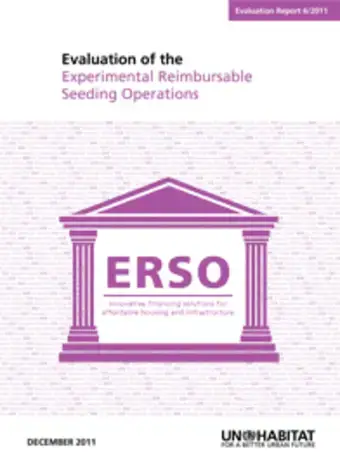
Evaluation of the Experimental Reimbursable Seeding Operations

The Experimental Reimbursable Seeding Operations (ERSO) programme was designed and implemented to increase sustainable financing for affordable and social housing and infrastructure during a four-year experimental pilot period, 2007–2011.

This report is the evaluation carried out to assess progress on implementation of the ERSO programme during the experimental pilot period, and to suggest alternatives for more effective implementation of future activities.