Small water utilities face unique challenges in delivering water and sanitation services to their customers. With a limited revenue base and few opportunities to benefit from economies of scale, they often suffer from severe skill shortages and a long legacy of under investment in infrastructure and capacity enhancement. To overcome these challenges, the small utilities need to maximize their operating efficiency and ensure optimum utilization of their assets.
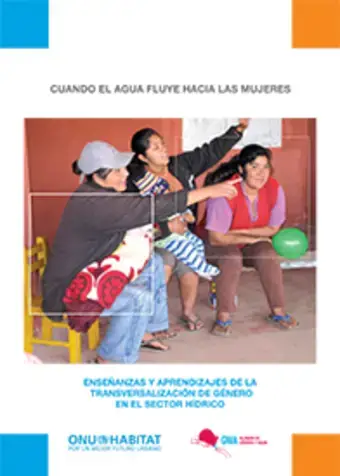
Este libro tiene por objeto sistematizar las enseňanzas y aprendizajes de la transversalizacion de genéro en el sector hídrico, en Bolivia, Ecuador y México. El propósito de presentar esta experiencia, no es sólo para justificar el porqué de la transversalización de genéro en el sector agua y saneamiento, ni para demostrar que la eficiencia de los sistems hídricos aumenta cuando hay una mayor participación de la mujer.
Es ante todo para mostrar cómo cualquier iniciativa de eficiencia y eficacia debe buscar, además de la satisfacción de ncesidades concretas, como lo son el acceso al agua y al saneamiento, promover procesos de transformación social. Desde esta perspectiva, la incorporación del enfoque de género en iniciativas del sector, implica una mayor sensibilización del significado, la importancia y el impacto que tiene la participación de las mujeres con toma de decisiones en pryectos de agua para uso doméstico y productivo, ello nos enfrenta a un gran desafío al que esperamos contribuir con la sistematizción de experiencias que se presentan en este estudio.
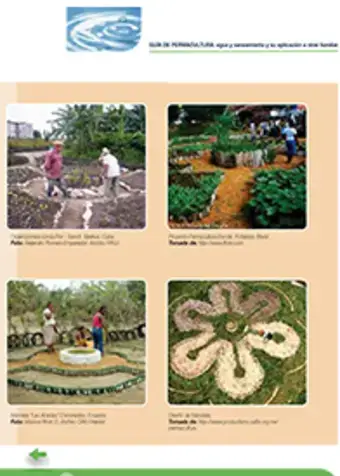
La permacultura parte del supuesto de que si queremos sobrevivir como especie, es imprescindible transitar de una cultura de consumismo hacia la cultura de la autosuficiencia local y la producción sustentable, buscando la progresiva reduccióndel consumo de recursos y energía1. Es decir, las sociedades humanas deben aprender a satisfacer sus necesidades dentro de ciertos límites ecológicos. Para ello es imprescindible recuperar y desarrollar una variedad de habilidades tanto conceptuales como prácticas.La sustentabilidad implica un equilibrio dinámico, no una condición estática, es un proceso de evolución más que una meta.
Los sistemas de permacultura persiguen desarrollar, a través del diseño y la aplicación de estrategias conscientes, ambientesconstruidos por los seres humanos con la capacidad de adaptación y recuperación ante situaciones cambiantes, que tienen los sistemas naturales.La presente guía pretende apoyar el proceso educativo que significa re-construir relaciones armónicas entre los seres humanos y la naturaleza. También se propone ayudar a promover la concepción de la permacultura, en su contribución a difundir la visión de ciclo cerrado como parte del manejo integral del agua y los nutrientes,en hábitats que garanticen la salud humana y ambiental de manera permanente.
Main Report of the First Water Sanitation Trust Fund - Impact Study , Document 01
This document is the overall summary and synthesis of the first impact study of initiatives supported by UN-HABITAT’s Water and Sanitation Trust Fund (WSTF).The WSTF, which was established in 2003, aims to leverage new investment and ideas to expand the water and sanitation (WATSAN) service coverage for poor urban dwellers and help build momentum for achieving the MDGs. Its strategic plan for 2008 - 2012 envisions three key outcomes: • Increased institutional capacity in partner countries for pro-poor water and sanitation initiatives and policies with focus on gender equity, renewable energy and efficiency and environmental sustainability;• Increased flow of investment into water and sanitation sector catalysed by WSTF interventions; • Improved MDG monitoring mechanisms in place in partner countries, with improved benchmarking of water and sanitation service providers. The UN-HABITATWater, Sanitation and Infrastructure Branch (WSIB) seeks to maximise the impact of projects funded by the WSTF, and this impact study is the first of a series of impact assessments which will be undertaken over the next five years.
This document is an internal Kenya country impact study of initiatives supported THE UN-HABITAT Water and Sanitation Trust Fund (WSTF). The objective of the WSTF, established in 2003, was to bring in new investment and ideas, expand service coverage for poor urban dwellers and help build momentum for achieving the MDGs.The impact study reviewed the overall strategy of the WSTF, examined the Kenya country context and the UN-HABITAT country strategy, and undertook an impact study of specific projects. Information was gathered from project documents, interviews with key stakeholders including project beneficiaries, and field visits.
This document is an internal Nepal country impact study of initiatives supported by UN-HABITAT’s Water and Sanitation Trust Fund (WSTF) undertaken by a team of international consultants. The objective of the WSTF is to bring in new investment and ideas, expand service coverage for poor urban dwellers, and help build momentum for achieving the MDGs. UN-HABITAT is a newcomer to the Urban WATSAN sector in Nepal, but has managed to establish itself as a notable development partner in this field. UNHABITAT’s comparative advantage is its focus on the complex problem of the urban poor, the ability to integrate WSS approaches across the urban sector, and community involvement from the outset of the project.
During the Water and Sanitation Trust Fund's Advisory Board meeting in 2010, the Government of Norway announced its intention to undertake an external evaluation of its support to the Trust Fund. Subsequently, the Governments of Norway, Spain and the Netherlands, in collaboration with UN-Habitat, decided to jointly undertake the evaluation.
The Mekong Region Water and Sanitation Initiative (MEK-WATSAN) - Assessment Report for the Roll Out Phase 1
The Mekong Region Water and Sanitation (MEK-WATSAN) Initiative was formulated in response to the GMS initiative as a collaborative effort between UN-HABITAT, the Governments of the Greater Mekong Sub-region and ADB.
The objective of the MEK-WATSAN Initiative is to support the participating countries in the Greater Mekong Sub-region (GMS) attain their water and sanitation related Millennium Development Goals (MDGs).
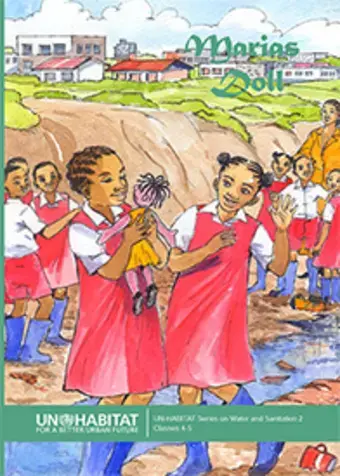
Maria's Doll: UN-Habitat Series on Water and Sanitation for Lower Primary
The heavens seem angry. The rain pounds the earth, lightening strikes and the thunder roars. People are frightened. Water sweeps carrying away things on its paths. Maria’s doll is swept away. Maria embarks on a search that leads her to an adventure of a lifetime. Will she ever find her doll? Find out in this surprising story.
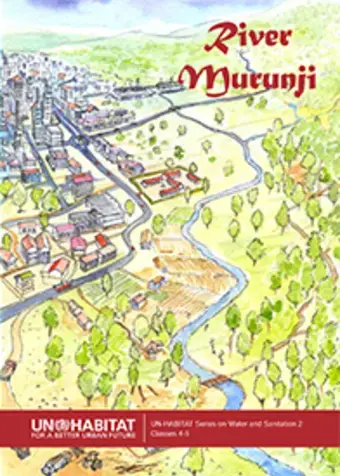
River Murunji: UN-Habitat Series on Water and Sanitation for Lower Primary
River Murunji has become dirty. Its water is drying up. However, one girl named Susana and her classmates fight for River Murunji. They set out in an exciting journey to get River Murunji to its original status of glory. Will they succeed? Read and find out!
 Share
Share