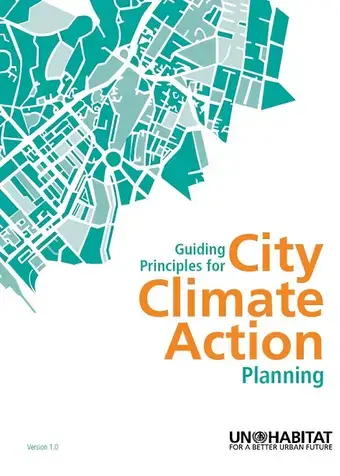
04 Dec 2015, Paris, France. UN-Habitat launched the ‘Guiding Principles for City Climate Action Planning’ on Friday at the Climate Change Conference COP-21 in Paris. The principles establish benchmarks for action planning in cities, based on international evidence and best-practices. “The new UN-Habitat Guide is all about orienting cities towards concrete, comprehensive climate action.
Guiding Principles for City Climate Action Planning
Other documents
UN-Habitat and UN CC:Learn launch an e-learning module on climate change and cities
 Nairobi, o3 December 2015 - UN-Habitat has developed together with UN CC:Learn, the One UN Climate Change Learning Partnership, an e-learning module on climate change and cities. This module responds to the need for climate change education for action on climate change to be possible.

UN Habitat Climate Change Strategy 2014-2019
 The purpose of the present Climate Change Strategy (2014-19) is to guide UN-Habitat in the mainstreaming of adaptation to and mitigation of climate change in all of its work. This reflects the designation of climate change as one of several cross-cutting issues at UNHabitat, per the Agency’s Strategic Plan (2014-19).
Hundreds attend exhibition on sustainable housing
 Kathmandu 24 August 2015—Hundreds of people including practitioners, entrepreneurs, and students attended a three-day exhibition on ‘Sustainable and Safer Housing Technologies’.