Download
Mid-Term Evaluation of the Cit
Share
Number of pages
92
Publication date
2013
Publisher
UN-Habitat

Mid-Term Evaluation of the Cities and Climate Change Initiative

This report represents the Mid-Term Evaluation of UN‑Habitat’s Cities and Climate Change Initiative. The Initiative was launched in 2008 and to date has been implemented in three phases: August 2008 to July 2010 (Phase I), August 2010 – December 2011 (Phase II), and January 2012 – December 2013 (Phase III).

Brief: EN | FR (PDF)

Download
Iraq
Share
Number of pages
88
Publication date
2013
Publisher
UN-HABITAT

Evaluation of the UN-Habitat Urban Programme in Iraq 2004-2012

The purpose of the evaluation was to assess the contributions of the UN-Habitat Iraq Urban Programme, the relevance of its programmatic focus, and the appropriateness of its institutional arrangements and partnerships. The evaluation also examined the added value of UN-Habitat within the context of joint programmes and identified lessons learned.

Operating within a challenging developmental context, the evaluation found that the Iraq Programme had made a visible and well-acknowledged contribution to the country's sustainable urbanization agenda in sectors of housing and land, urban planning, water and sanitation, infrastructure and broader issues of governance and protection.

Download
Mavoko Municipality, Kenya
Share
Number of pages
86
Publication date
2012
Publisher
UN-HABITAT

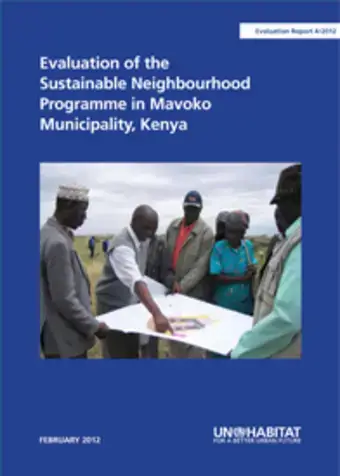
Evaluation of the of the Sustainable Neighbourhood Programme in Mavoko Municipality, Kenya.

The Sustainable Neighbourhood Programme was designed as an experimental, community-driven slum resettlement project, expected to address the housing crisis in Kenya by focusing on improving the lives and livelihoods of people living in 26 slum settlements in Mavoko, Kenya.The evaluation was a response to the request by the Government of Finland for a final evaluation of the achievements, experiences, challenges, and lessons learned.

The evaluation found that the project strengthened community capacity through the sensitization, mobilization, and training of men, women, and youth living in the slum settlements who were able to better define their role in creating healthy, sustainable neighbourhoods and also implement steps to improve their own lives by working together.

Download
Review of UN-Habitat's Partici
Share
Number of pages
84
Publication date
2011
Publisher
UN-HABITAT

Review of UN-Habitat's Participation in the Delivering as One UN Initiative

The review covers the opportunities and challenges of UN-Habitat's participation in the Delivering as One (DaO) United Nations Initiative, and makes recommendations for a more rational, coherent and effective participation. UN-Habitat is currently active in six pilot DaO countries: Cape Verde, Mozambique, Pakistan, Rwanda, Tanzania and Vietnam.

The review was requested by the UN General Assembly, for consideration by Member States, and conducted by two independent consultants during the period from March to June 2011. A key finding of the review is that effective participation of UN-Habitat in joint programming has the potential to enhance its visibility and sharpen its comparative image.

It also finds that establishment of National Urbanisation Committees or National Urban Forums with membership drawn from the Government, civil society groups and the private sector will be important to position the urban agenda at country level, and that UN-Habitat Headquarters should streamline its structure and working modality to enable it to "deliver as one".

Download
Evaluation of the Experimental
Share
Number of pages
109
Publication date
2011
Publisher
UN-HABITAT

Evaluation of the Experimental Reimbursable Seeding Operations

The Experimental Reimbursable Seeding Operations (ERSO) programme was designed and implemented to increase sustainable financing for affordable and social housing and infrastructure during a four-year experimental pilot period, 2007–2011.

This report is the evaluation carried out to assess progress on implementation of the ERSO programme during the experimental pilot period, and to suggest alternatives for more effective implementation of future activities.