The Implementation of the Principles of Planned Urbanization: a UN-Habitat Approach to Sustainable Urban Development
The paper elaborates on the conceptual and practical framework of the principles of planned urbanization, characteristic of the integrated approach adopted by UN-Habitat to address the challenges of rapid urbanization in the developing world, namely (1) Rules and Regulations, (2) Urban Design, and the (3) Financial plan.
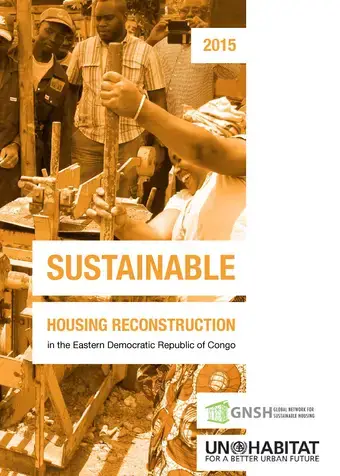
Sustainable Housing Reconstruction in the Eastern Democratic Republic of Congo
Due to a more stable phase in the prolonged conflict of the Eastern Democratic Republic of Congo, UN-Habitat recommends the initiation of permanent reconstruction and moving away from an emergency shelter in the area. The reconstruction process is recommended to reflect the local political, socio-cultural and physical context of the area and build on sustainable use of local building materials. In addition, generation of employment and local economic development through participatory processes and capacity building of community members is a key objective
Mainstreaming Sustainable Social Housing in India (Findings and insights from the MaS-SHIP project)
This report describes the wider context, objectives, methodology, and findings of a two-year research project entitled MaS-SHIP. Funded by the United Nations Environment’s Sustainable Buildings and Construction programme of the 10 Year Framework Programme. MaS-SHIP has produced a comprehensive data framework, tools, evidence-based knowledge, insights and policy recommendations for mainstreaming sustainable social housing in India.
A socio-technical approach was adopted in the research, bringing together primary and secondary data collection with both quantitative and qualitative assessments, using literature review, stakeholder engagement, online and field surveys, statistical tests, and thermal simulations. The construction and policy ecosystem were examined to identify barriers and opportunities in adopting sustainable building materials and related design and construction practices, so as to develop policy recommendations.
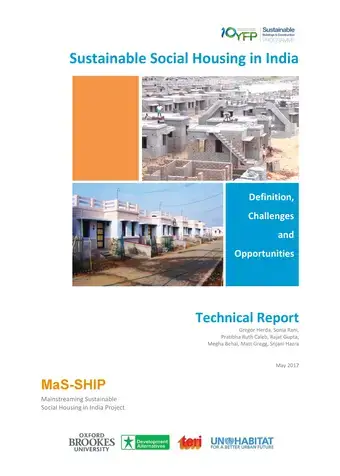
Sustainable Social Housing in India: definitions, challenges, and opportunities
While more often than not, ‘housing’ is defined as a basic need which provides family access to shelter and basic amenities, also enabling the creation of demand for resources, physical infrastructure, labour, technology, finance, and land. Housing is a physical manifestation of social and cultural practices and forms an integral part of the assessment of the development and health of an economy.
Thus housing refers not only to the physical structure of a house but its forward and backward linkages to job creation, resource requirements, institutional and regulatory systems, supporting infrastructure, services, and social cohesion.
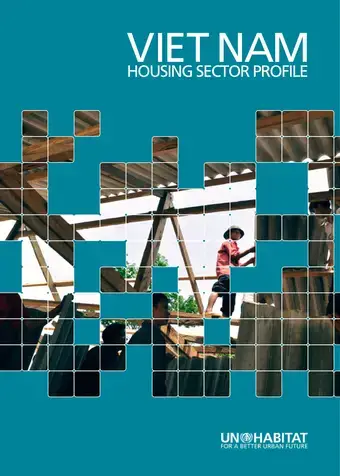
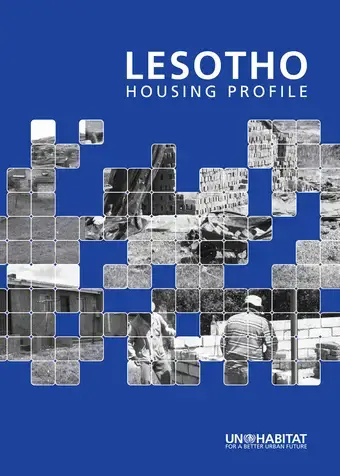
The profile offers a comprehensive in-depth analysis of the country’s urban housing sector. The Profile contributes to the creation of a policy framework that enables the provision of adequate housing for all. It builds a comprehensive understanding of the functioning of the urban housing sector that can serve as an authoritative reference point for all actors involved in the direct provision or enablement of housing
The profile offers a comprehensive in-depth analysis of the country’s urban housing sector. The Profile contributes to the creation of a policy framework that enables the provision of adequate housing for all. It builds a comprehensive understanding of the functioning of the urban housing sector that can serve as an authoritative reference point for all actors involved in the direct provision or enablement of housing
The profile offers a comprehensive in-depth analysis of the country’s urban housing sector. The Profile contributes to the creation of a policy framework that enables the provision of adequate housing for all. It builds a comprehensive understanding of the functioning of the urban housing sector that can serve as an authoritative reference point for all actors involved in the direct provision or enablement of housing.
Mediterranean City-to-City Migration: Dialogue, Knowledge and Action
The Mediterranean City-to-City Migration Project (MC2CM) brings together experts and cities to contribute to improved migration governance at city level, including migrants' access to basic services and human rights. Implemented since 2015, the project is working with the cities of Amman, Beirut, Lisbon, Lyon, Madrid, Tangiers, Tunis, Turin and Vienna to increase the knowledge base on urban migration and nurture a peer-to-peer dialogue to support mutual learning on specific urban challenges such as social cohesion, intercultural dialogue, employment and provision of basic services for migrants, among others.
United Nations Human Settlements Programme (UN-Habitat),
Vietnam National Report for United Nations Conference on Housing and Sustainable Urban Development (HABITAT III)
A report that reviews the urbanization process over the last 20 years, analyses existing issues and new challenges and provide orientations for future urbanization
 Share
Share