Overview
Advancing Sustainable Urban Transformation in the Kingdom of Saudi Arabia
UN-Habitat has been supporting the Kingdom of Saudi Arabia since 2014 in advancing sustainable, inclusive, and people-centred urban development aligned with Vision 2030, the New Urban Agenda, and the Sustainable Development Goals (SDGs)
Working in partnership with national and local institutions, UN-Habitat supports integrated urban planning, housing, municipal governance, quality of life enhancement, spatial planning reform, climate-responsive urban development, smart cities, and SDG localization across the Kingdom.
Saudi Arabia represents one of UN-Habitat’s most dynamic urban transformation partnerships globally, contributing to innovative urban solutions that strengthen sustainability, resilience, prosperity, and livability.
This page is currently being updated and expanded. Additional programme and partnership information will be added soon.
Country: Overview
Country: Overview
Country: Overview
Saudi Arabia is undergoing rapid urban transformation aligned with Vision 2030, creating opportunities to advance sustainable urbanization, integrated spatial planning, infrastructure efficiency, and enhanced quality of life across the Kingdom. As cities continue to grow and expand, priorities include promoting balanced territorial development, climate resilience, sustainable mobility, resource efficiency, improved waste management, and more integrated urban governance systems. Strengthening secondary cities, enhancing public spaces, and advancing data-driven and people-centred urban solutions are also key national priorities. These efforts are contributing to more sustainable, resilient, and inclusive cities and communities across the Kingdom.
Country: Impact and Urban Numbers
Saudi Arabia continues to advance major urban and spatial planning reforms aligned with Vision 2030, including the development of the National Urban Policy, the Spatial Planning Act, and the modernization of municipal and territorial planning systems.
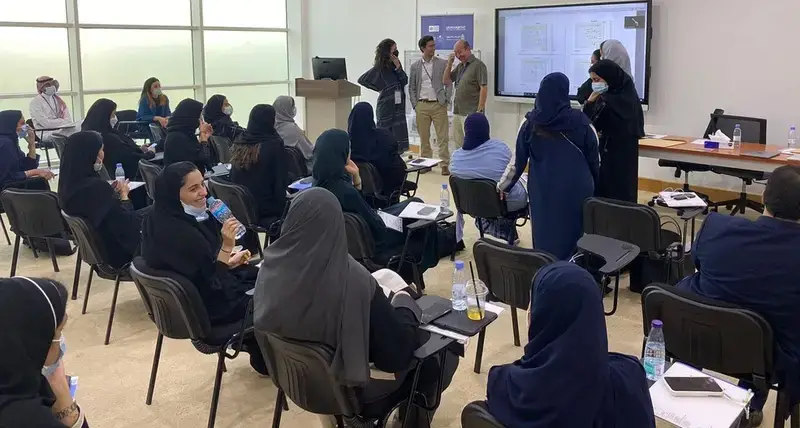
Through national urban dialogue platforms, workshops, and forums, thousands of stakeholders from government, academia, the private sector, civil society, and local communities have contributed to shaping the future of sustainable urban development in the Kingdom.
The Kingdom is also advancing the review and modernization of national and regional spatial planning frameworks to support balanced territorial development, improved urban governance, infrastructure coordination, climate resilience, and enhanced quality of life across Saudi cities and regions.
National bus ridership within cities exceeded 96.8 million passengers in 2025, while the Riyadh Metro recorded more than 100 million passengers in its first nine months of operation.
Public space per capita increased from 5.2 m² in 2021 to 6.9 m² in 2024, with 74.89% of residents now having access to public spaces.
Homeownership reached 66.24% in 2025, reflecting continued progress in housing accessibility and affordability.
Featured Stories & Videos
Country Beneficiaries
Donors and partners
UN-Habitat’s work in the Kingdom of Saudi Arabia is built on strong partnerships with national and local institutions to advance sustainable urbanization, housing, spatial planning, municipal governance, and quality of life in line with Vision 2030 and the Sustainable Development Goals.
UN-Habitat works closely with the Ministry of Municipalities and Housing (MOMAH) and other partners on initiatives related to the National Urban Policy, spatial planning reform, municipal governance, SDG localization, housing, public spaces, urban resilience, urban analytics, and capacity-building. Collaboration with the Quality of Life Program Center, the Royal Commission for AlUla, municipalities and Amanat, and other national institutions support people-centred, data-driven, and integrated approaches to sustainable urban development across the Kingdom.
Through these partnerships, UN-Habitat supports innovative, inclusive, and climate-responsive urban solutions that contribute to more sustainable, resilient, and prosperous cities and communities for all.
Donors
Contact
Highlighted Publications

Transit-Based Regeneration Arar: From Highway to Boulevard
UN-Habitat’s three-pronged approach considers spatial planning in relation to legal and institutional frameworks, in addition to financial mechanisms. The demonstration project for Arar has been elaborated to include schematic designs and feasibility studies, that can later be transformed into…
+ DOWNLOAD
CPI PROFILE Tabouk
Under the FSCP, UN-HABITAT, MOMRA, Municipality and its Local Urban Observatory has been working on developing urban statistic and spatial information (Geographic Information System) to provide relevant urban information that strongly supports decision-making process on urban development and urban…
+ DOWNLOAD
CPI PROFILE Buraidah
Under the FSCP, UN-HABITAT, MOMRA, Municipality and its Local Urban Observatory has been working on developing urban statistic and spatial information (Geographic Information System) to provide relevant urban information that strongly supports decision-making process on urban development and urban…
+ DOWNLOAD
Urban Landscapes Integration Al-Ahsa: An Urban Cultural Oasis
UN-Habitat’s three-pronged approach considers spatial planning in relation to legal and institutional frameworks, in addition to financial mechanisms. The demonstration project for Al Ahsa has been elaborated to include schematic designs and feasibility studies, that can later be transformed into…
+ DOWNLOAD
Sustainable Densification: Buraidah Integrated Neighbourhood
As an extension of the Buraidah City Profile, the demonstration project will apply the United Nations Human Settlements Programme (UN-Habitat) principles on sustainable neighbourhood planning, applicable to the Saudi context. One of the primary goals of the project is to demonstrate how to…
+ DOWNLOAD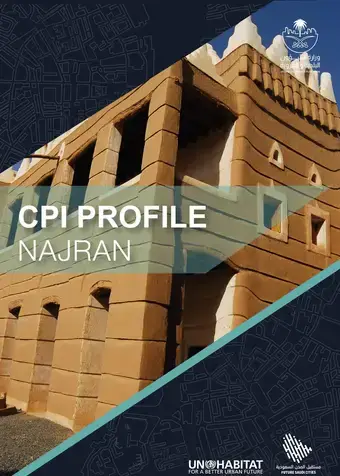
CPI PROFILE Najran
Under the FSCP, UN-HABITAT, MOMRA, Municipality and its Local Urban Observatory has been working on developing urban statistic and spatial information (Geographic Information System) to provide relevant urban information that strongly supports decision-making process on urban development and urban…
+ DOWNLOADLegacy content
Saudi Arabia’s cities are urbanizing fast with urban population almost tripled from 9.32 million in 1980 to 29.8 million in 2014. In addition, urbanization is expected to continue its increase to reach up to 97.6 % by the year 2030, out of which Riyadh (the capital) will reach 8.2 million out of which 75 % will be Saudis. In light of the current growth rates and the Kingdom’s long-term demographic estimates, the annual demographic growth in the Kingdom is expected to reach an average of 0.87 %, bringing the number to about 31.457 million in 2030, of which 4.214 million are non-Saudis. Most of the population is concentrated in the capital Riyadh, the secondary cities Jeddah and Dammam, and the holy cities of Mecca and Medina.
This calls for an urgent need to address the negative externalities and imbalances of urban growth and maximize the benefits of urbanization through balanced territorial development. With the new custodian of the two holy Mosques, King Salman Al-Saud, a new government was formed with a new Economic and Development Council that approved the Ministry of Municipal and Rural Affairs strategy in February 2015. The new strategy has taken into consideration the direction for sustainable development and the new urban agenda’s three pronged approach. The strategy aims to achieve balanced and sustainable urban development and outstanding municipal services in a context of justice and competiveness in all regions. Sustainable urban development practices will require larger room and mechanisms for the people’s participation in what matters to them. Saudi Arabia aims to take its cities to a level of sustainable urbanization that addresses these factors.
This is to be realized by forming urban environments of high efficiency that fulfil the expectations and needs of current and future generations, which provide high standards of living as well as developed and planned communities which all citizens of the Kingdom of Saudi Arabia can feel proud of and where they can work, live and enjoy amenities and opportunities that meet or exceed international standards. By utilizing UN-Habitat’s principles of sustainable urbanization, the three pronged approach and the City Prosperity Initiative as entry points, Saudi cities will be capacitated to address urban development in a more inclusive and multi-dimensional way.
The Future Saudi Cities Programme is currently being implemented by UN-Habitat and the Secretariat of City Planning in the Ministry of Municipal and Rural Affairs, its goals, prescribed results and outputs are fully aligned with the Ministry’s new vision, set of goals and objectives as well the Sustainable Development goal 11 “Make cities inclusive, safe, resilient and sustainable”.
Tarek El-Sheikh, Ph.D.
UN-Habitat Programme Director
Kingdom of Saudi Arabia
MAIN PARTNER: Ministry of Municipal and Rural Affairs
His Highness, the Minister of Municipal and Rural Affairs headed the Kingdom’s delegation to the sixth session of the World Urban Forum (WUF) held in Napoli – Italy during September 2012 (Shawwal 1433H) organized by United Nations Program for Human Settlements “UN-Habitat”.
During the bilateral meetings of H.H. the Minister and H.E. the Undersecretary with the UN-Habitat officers within the forum’s events, an idea was suggested for signing a mutual agreement with UN-Habitat to develop a modern planning strategy and vision for the Saudi Cities.
A proposal was raised to His Majesty to seek the assistance of UN-Habitat’s experience and the involvement of both the Minister of Finance and the Minister of Economy and Planning.
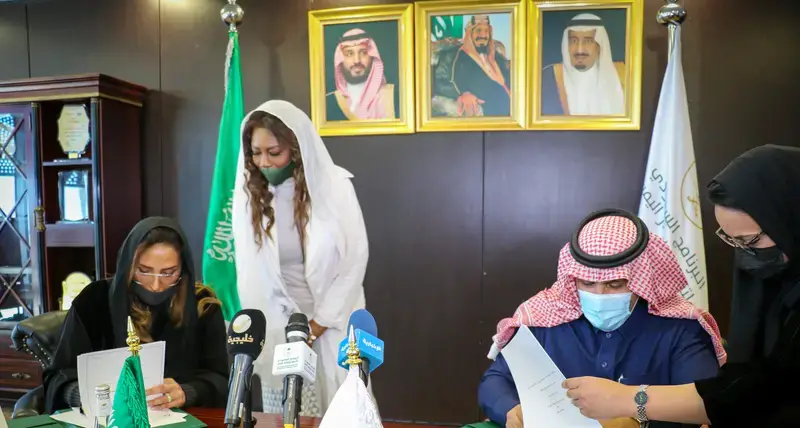
As a result, a Memorandum of Understanding –MoU- was signed between the Ministry and UN-Habitat for the implementation of the “Saudi Cities Program”.