RISE-UP: Resilient Settlements for the Urban Poor
Summary
RISE-UP: Resilient Settlements for the Urban Poor improves the socio-economic prosperity of the urban poor by reducing climate disruptions and enhancing service provisions and community resilience. RISE-UP provides comprehensive technical assistance to integrate pro-poor climate action in national and local policy and planning frameworks and engages at the local level to facilitate community driven profiling and planning processes. Working at multiple levels provides enabling factors for RISE-UP partners to help prepare and mobilize investment into global hotspots of urban climate vulnerability.
Challenges addressed
One of the greatest challenges for climate change adaptation is how to build resilience for the almost one billion urban dwellers who live in informal settlements today. The impacts of climate change, such as floods, heatwaves, droughts, landslides, storms, coastal erosion and inundation, and sea surges, are affecting cities around the world. The expected climatic changes in means (temperature, precipitation, and sea-level rise), extremes (extreme rainfall, drought, heat- or cold-waves) and changes in exposure resulting in population movements and bio-climatic changes, will have particularly severe impacts on informal settlements. The heightened vulnerability is due to three underlying factors:
- the physical location is often on fragile sites such as steep slopes, coastlines or floodplains; (
- the socio-economic characteristics of the residents, such as high levels of poverty and illiteracy, mean that these communities have low capacity to deal with climate impacts; and
- the political and institutional marginalization of these communities, stemming from non-recognition of informal settlements as part of the larger city fabric, often results in the absence of meaningful investments in risk-reducing services and infrastructure.
A second challenge is to channel climate investments to where it matters most, at the local level. The local and national finance gap is compounded by the fact that also globally, only around 5 to 8 per cent of climate finance goes to adaptation, a fraction of what is needed in the rapidly growing cities.
Quote
Mr. Frank Bainimarama
“With more and more of the world’s citizens living in unsustainable informal settlements and with climate change worsening as global temperatures rise, the need to “rise up” is clear to address the sustainability of our urban poor. Fiji strives for that future every day. We do so for our sake, particularly for those of our most vulnerable ones. But we also do so knowing that our successes are shared by our fellow global citizens. Every problem we solve adds knowledge and experience that strengthens cities and communities across our region and around the world."
What UN-Habitat can offer
UN-Habitat’s long-standing experience gained through the implementation of the climate and slum-upgrading programmes signals the need for addressing those two issues in an integrated manner. Since 2016, the agency has piloted this integrated approach in 14 countries, developed tools and methodologies, and the operational concept proven to be of high-impact and able to leverage significant amounts of climate co-funding2 . Through the agency’s lead role in building a global coalition for climate action for the urban poor as part of the efforts to support the United Nations Secretary General’s 2019 Climate Summit, UN-Habitat has helped shape a unique global partnership for policy and advocacy impact, and the present flagship programme can be understood as the complementary operational initiative to deliver transformative impact on the ground to complete the ‘do’ aspect of the four dimensions of our new approach: think, do, share and partner.
- Supports governments and investors to collect and make appropriate use of data and methodologies;
- Bridges city issues to global debates and global policy to local city actions; harmonizing and synergizing pro-poor climate action along the global – national – local – community level; and
- Supports national governments to shape policies and frameworks, and help cities improve plans and strategies.
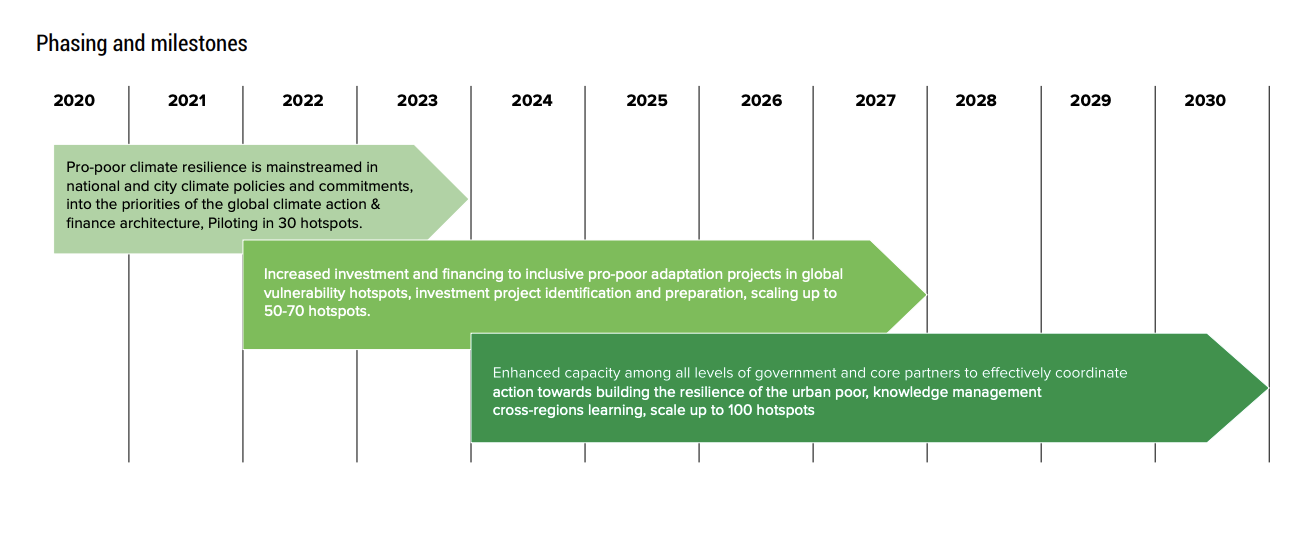
Potential locations for the roll-out of the flagship programme have been identified in around 140 cities in 40 countries (48 cities in Africa, 57 in Asia and Pacific and Arab States, 35 in Latin America and the Caribbean). The proposed first phase until 2023 is targeting 30 cities in 26 countries, with phase two (2023–2030) targeting more than 80 million people in up to 100 cities across the globe.
Duration of support
The Flagship Programme will be a reliable development partner to cities and national governments until 2030. City-level processes will range in duration from profiling (six months), planning (6–8 months) to identifying and completing investments (3–4 years), typically taking 3–5 years in total. Improving national enabling environments typically requires long-term processes as well and are estimated to range from support to NDC/NAP development (three months) to more sophisticated policy support processes (1–2 years).
Phasing and milestones
Related SDGs