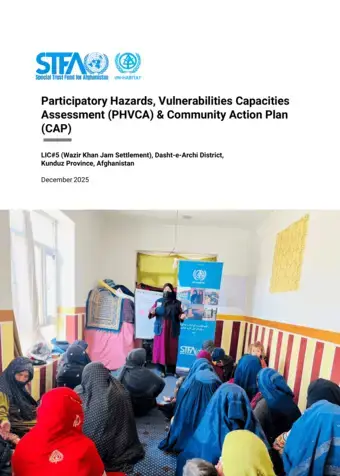
Community Engagement as Crucial Step for Advancing Durable Solutions for Returnee Integration in Afghanistan: Participatory Hazards, Vulnerabilities, Capacities Assessment (PHVCA) & Community Action Plan (CAP)
Afghanistan has faced a major returnee crisis since September 2023, with more than 2.8 million people having returned to the country in 2025 only. The Integration of returnees is a major component - allowing them to advance towards durable solutions to displacement. In order to strengthen social cohesion with local communities, UN-Habitat fosters participatory and inclusive, community-driven processes. Listening to communities, including both local and displaced people, understanding their specific needs but also analysing climate-change related risks are first crucial steps for then programming for durable solutions that are tailored to the local context as well as based on people’s priorities.
UN-Habitat has implemented the “Participatory Hazard, Vulnerabilities, Capacity Assessment” (PHVCA) more many years, to ensure that people’s voices are heard and that local knowledge (on risks and opportunities) is captured. The findings of the PHVCA then informs Community Action Plans (CAPs) and allows programming and implementation of community projects that serve displaced people, returnees and local communities through an area-based approach.
Participatory processes foster integration and social cohesion, investments in community infrastructures and basic services, shelter and housing solutions and enabling livelihood opportunities are key for enabling returnees to become self-reliant and live in dignity.
 Share
Share