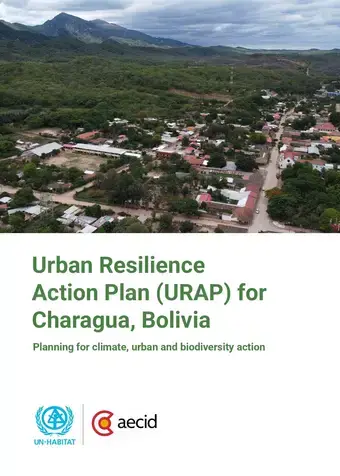
The Urban Resilience Action Plan (URAP) for Charagua provides a strategic and operational framework to strengthen resilience to climate change, environmental degradation, and territorial pressures in an indigenous autonomous context. Developed under UN-Habitat’s Resilient Settlements for the Urban Poor (RISE UP) programme, the URAP translates the findings of the Multilayered Vulnerability Assessment (MVA) into a set of prioritized, feasible, and culturally grounded actions.
Charagua, located in the Bolivian Chaco, faces increasing challenges related to climate variability, water scarcity, ecosystem degradation, and changes in land use that directly affect livelihoods, food security, and community well-being. As an Indigenous Autonomous Territory, governance structures, community participation, and the relationship with the territory play a central role in shaping resilience strategies.
The URAP was developed through a participatory and inclusive process involving local authorities, technical teams, and indigenous communities. Priority actions were identified through multi-criteria analysis, considering resilience benefits, technical and financial feasibility, social inclusion, and alignment with indigenous governance and territorial planning processes. The resulting action portfolio emphasizes ecosystem-based adaptation, sustainable water and land management, risk reduction, and capacity building at the community level.
Aligned with national and local planning instruments and international frameworks such as the Paris Agreement and the Sustainable Development Goals, the URAP for Charagua serves as a practical tool to guide public investment, support the development of fundable projects, and advance climate adaptation and resilient development rooted in indigenous autonomy and territorial governance.
 Share
Share