Kampala, 12 August 2026 — Nearly half of Kampala’s Kiteezi landfill has been rehabilitated and handed over to Kampala Capital City Authority (KCCA) last week, marking the completion of the first phase of an emergency effort to stabilize Uganda’s largest dumpsite. The rehabilitation was carried out by UN-Habitat in partnership with KCCA, funded through a USD 1 million grant from the Government of Japan.
The handover ceremony was attended by senior government and United Nations officials, including Prime Minister of Uganda Robinah Nabbanja, Minister of State for Kampala Capital City and Metropolitan Affairs Kyofatogabye Kabuye, Japan’s Ambassador to Uganda Sasayama Takuya, UN Resident Coordinator Leonard Zulu, and Japan International Cooperation Agency (JICA) Chief Representative Osaki Matsuhiro.
The dumpsite, which collapsed in August 2024, claimed 46 lives, destroyed 72 homes and displaced many others. It also blocked a nearby stream, triggering floods, contaminating downstream water sources and disrupting solid waste collection across Kampala, which called for an emergency intervention.
“We are grateful to UN-Habitat for its support in securing the grant from the Government of Japan and for its technical expertise throughout the rehabilitation of the Kiteezi dumpsite,” said Prime Minister Robinah Nabbanja at the handover ceremony. “This partnership has been critical to the success of the project,” she noted.
The rehabilitation focused on the landfill’s highest-risk sections, rather than the entire site. As a result, 16 acres of the 36-acre landfill have been stabilized, reducing immediate instability risks and improving safety for neighbouring communities. An estimated USD 5 million in additional funding will be required to complete work on the remaining 20 acres, according to State Minister Kabuye.
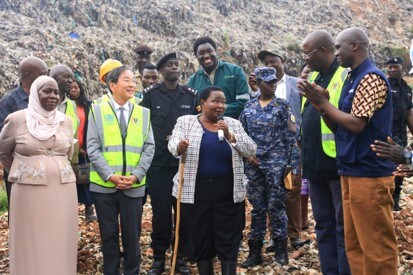
Robinah Nabbanja, Prime Minister of Uganda (centre), during the handover ceremony of the rehabilitated section of Kiteezi landfill on 5 August 2026. The rehabilitation was carried out by UN-Habitat in partnership with KCCA, with support from the Government of Japan.
The Fukuoka Method for landfill safety
The rehabilitation applied the internationally recognized Fukuoka Method to improve landfill stability and control leachate and methane gas to reduce the risk of landslides, environmental pollution and gas explosions.
Engineered benches, embankments and reshaped slopes were constructed to stabilize vulnerable waste masses. More than 1,200 vertical gas venting and horizontal leachate collection pipes were installed, alongside nature-based leachate treatment ponds that safely treat contaminated run-off before it is released into the environment.
The project builds on UN-Habitat’s wider application of the Fukuoka Method across Africa. Earlier this year, UN-Habitat completed the first Fukuoka landfill cell in Berbera, “Somaliland”, providing the city with an environmentally sound waste disposal facility. The method’s successful application in both Berbera and Kampala points to its adaptability across different urban contexts, while advancing local technical capacity and promoting sustainable solid waste management across the region.
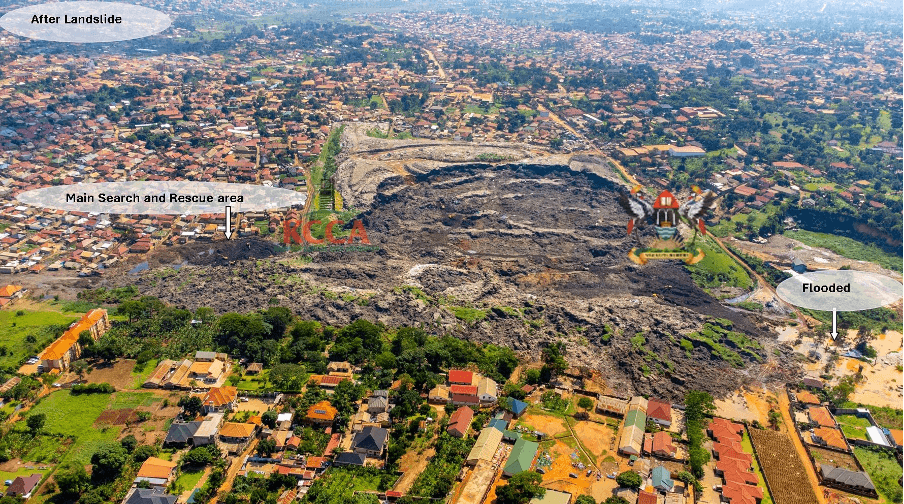
A view of Kiteezi landfill, Uganda’s largest dumpsite, after part of the site collapsed in August 2024. © Kampala Capital City Authority
Local solutions create jobs and build capacity
“One of the most promising aspects of this project is that it did not rely solely on imported solutions. We deliberately invested in local innovation, including supporting WastePlus, a Ugandan youth-led enterprise, to develop recycled plastic pipes for leachate collection and gas venting,” said Grace Lubaale, a project manager at UN-Habitat. “This shows that local entrepreneurs can provide practical, sustainable solutions to complex urban waste management challenges while creating green jobs and building local capacity.”
With technical support from Fukuoka Method experts, the pipe designs were refined for durability and ease of installation – showing how plastic waste can be transformed into essential infrastructure through Uganda’s circular economy.
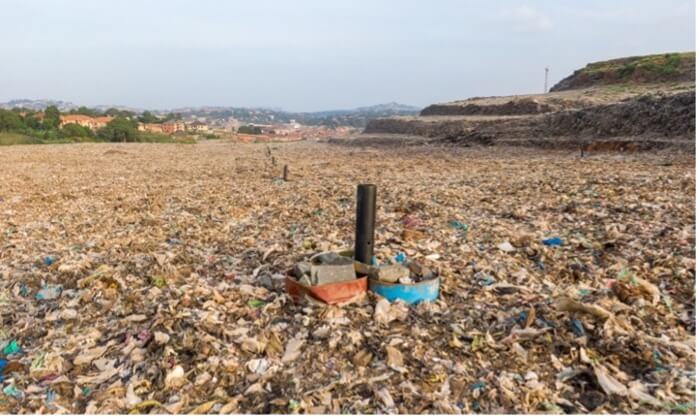
The gas ventilation system installed on site. © UN-Habitat
The project also showed how environmental restoration can support livelihoods. About 30,000 temporary jobs were generated for youth and women from the production of recycled-plastic pipes for the rehabilitation.
The initiative also included practical training for KCCA staff and machine operators to ensure that the knowledge and skills needed to sustain safer landfill operations continue well after the rehabilitation project concludes.
Building resilience against future disasters
The handover follows the Government of Uganda’s recent launch of a national cleaning day.
“The National Cleaning Day is a commendable initiative that demonstrates Uganda’s commitment to improving environmental sanitation,” said Ambassador Sasayama Takuya. “As more waste is collected, it is essential that there is a sustainable plan for where it will be disposed of. Investments in landfill systems, such as Kiteezi, are critical to ensuring that waste is managed safely and does not create new environmental or public health risks.”
UN-Habitat is working with partners to develop waste management strategies for Uganda’s secondary cities, many of which face similar risks, and strengthen resilience against future disasters.
Cover photo: The Kiteezi landfill after rehabilitation using the Fukuoka method in May 2026. © UN-Habitat