Nairobi, 3 September 2026 — How can governments ensure housing policies respond to the needs and rights of all? This question was at the centre of the intersessional meeting of the Open-ended Intergovernmental Expert Working Group on Adequate Housing for All (OEWG-H), held in Nairobi and online.
Co-chaired by Azerbaijan and Somalia, the meeting focused on how Integrated National Housing Policies (INHPs) can connect housing with social, economic, environmental and spatial policies to promote adequate housing for all. It brought together approximately 265 participants, including around 240 external participants. Member States, housing experts, academics and practitioners tested draft recommendations against national experiences, focusing on how integration could work in different country contexts.
“Housing outcomes are shaped by decisions taken across many parts of government and different levels. The question for us is how these decisions can reinforce one another rather than walk in parallel or at times against one another,” said Jabril Ibrahim Abdulle, Ambassador of Somalia to Kenya and Co-chair of the Working Group.
In a video message, UN-Habitat Executive Director Anacláudia Rossbach said housing laws, subsidies, land systems, urban policies and finance mechanisms often operate separately. “Integration connects them across sectors, levels of government, territories and policy cycles,” she explained.
Integrated Housing Policies was one of three thematic priorities in the OEWG-H’s 2026 programme. The meeting built on the Expert Group Meeting in July and will inform recommendations to be considered at the third session of the Working Group in Nairobi on 26 and 27 November. Established by UN-Habitat Assembly resolution 2/7 in June 2023, the OEWG-H is expected to present its full set of recommendations to the United Nations Habitat Assembly in 2029.
Why adequate housing matters now
The need for action is urgent. Up to 3.4 billion people live without secure, safe and adequate housing, including around 1.2 billion in informal settlements and slums. Housing costs are also rising faster than incomes in many places, making adequate and affordable housing increasingly difficult to access.
Climate change is adding to these pressures. An estimated 167 million homes are projected to be at risk from climate-related impacts by 2040, with informal settlements and low-income communities particularly exposed.
These challenges show how housing outcomes are shaped by policies beyond the housing sector, including land, infrastructure, finance, planning, social protection and the environment.
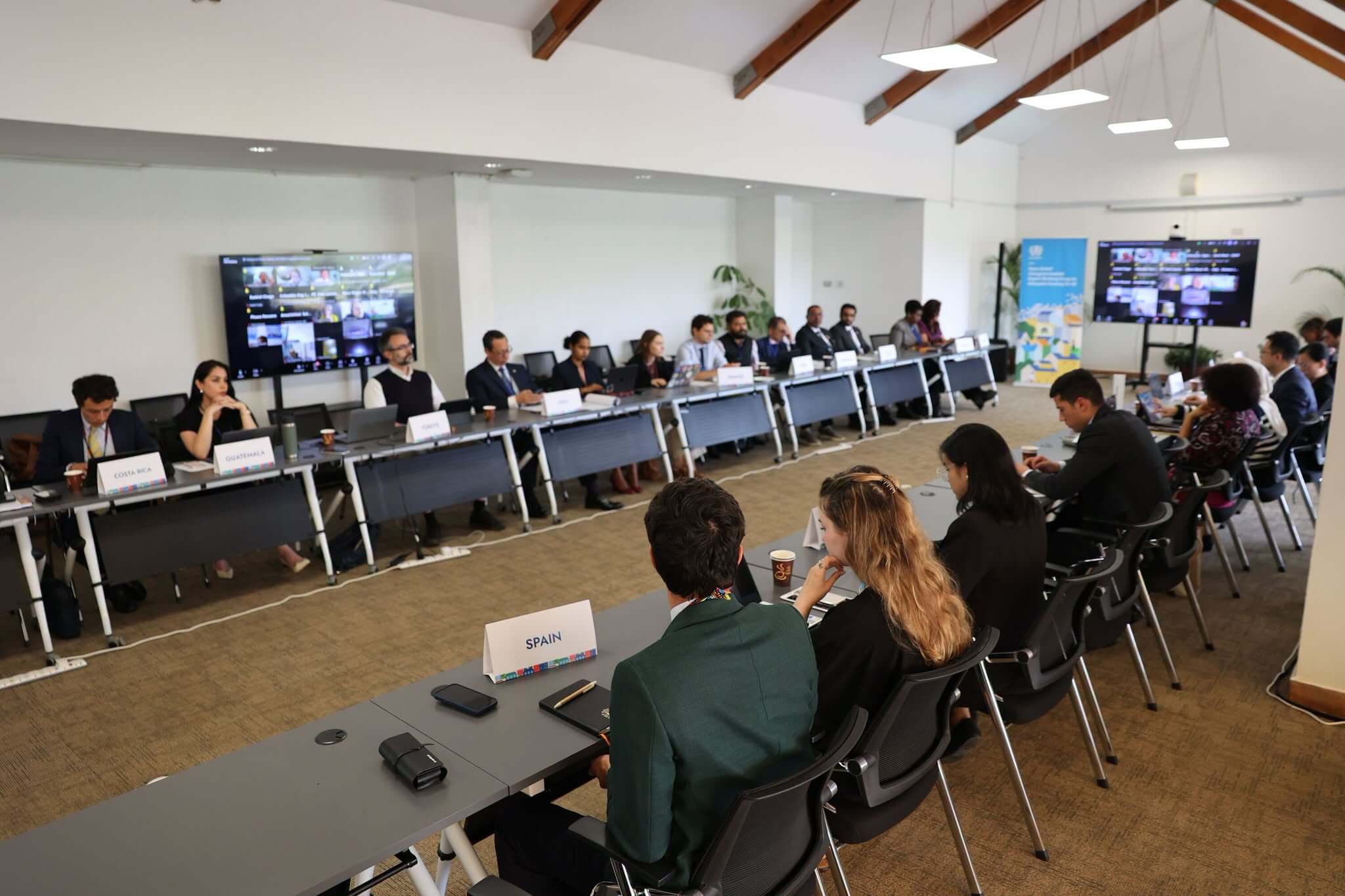
Government representatives, housing experts, academics and practitioners participate in the intersessional meeting of the Open-ended Intergovernmental Expert Working Group on Adequate Housing for All (OEWG-H) in Nairobi on 3 September 2026. © UN-Habitat/Michael Kariuki
From fragmented policies to integrated systems
UN-Habitat analysis of national housing policies in 159 countries shows that nearly two thirds of the surveyed countries have some form of national housing policy. While these policies provide an important starting point, the analysis suggests that separate policies and measures may not be sufficient on their own. INHPs could provide a framework for connecting these efforts.
Participants examined draft recommendations on how integrated approaches could clarify responsibilities, strengthen policy coherence and provide an overarching framework for the OEWG-H’s more sector-specific recommendations.
The proposed approach identifies four dimensions of integration: horizontal, connecting housing with other policy sectors; vertical, connecting levels of government; spatial, linking housing to services, infrastructure and opportunities; and temporal, connecting policies across time and policy cycles.
The meeting underscored that there can be no single pathway to integration. Countries could identify entry points suited to their own housing challenges, institutions and capacities. These could be thematic, institutional, temporal or capacity-based.
Making integration work in practice
Sahar Attia, Emeritus Professor of Architecture and Urban Design at Cairo University and Chair of the UN-Habitat University Network Initiative, also called for a shift from fragmented housing interventions towards integrated housing systems. She proposed a six-step approach, including diagnosing the housing system, aligning policies, and creating continuous learning and adaptation.
“Housing systems are not static,” Attia said. “A national housing policy cannot be a document produced once every 10 years or so. It should operate as a continuous learning cycle with potential of adaptation.”
The open discussion brought these ideas into country contexts. Member States highlighted land and finance, coordination across levels of government, disaster and post-conflict recovery, informal settlements and diverse forms of tenure. They also raised the importance of data, affordability, meaningful participation and political will for implementation.
The discussion will inform the continued development of the draft recommendations ahead of the third session of the Working Group in November and the wider work of the OEWG-H towards its full set of recommendations for the United Nations Habitat Assembly in 2029.
Cover photo: The Co-Chairs of the OEWG-H during the intersessional meeting on Integrated National Housing Policies in Nairobi on 3 September 2026. © UN-Habitat/Michael Kariuki