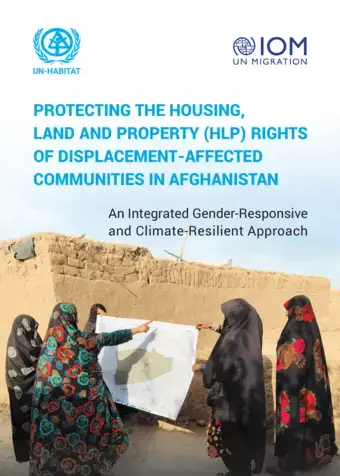
Protecting the Housing, Land, and Property (HLP) Rights of Displacement-affected Communities in Afghanistan
Afghanistan faces complex displacement and reintegration challenges. Decades of conflict have resulted in a legacy of 6 million Internally Displaced People (IDPs), while an emerging post-conflict trend has seen a surge in cross-border returns – between 600,000 and 1.5 million people have been forcibly returned to Afghanistan since 2023. In this context, Afghanistan’s informal settlements are emerging as key sites of displacement, hosting large populations of both protracted IDPs and recent returnees.
Residents of informal settlement face severe HLP risks, including growing threats of eviction, which have limited investments in housing, critical infrastructure and services. Afghanistan’s climate breakdown exacerbates these challenges, exposing vulnerable residents to floods, droughts and associated disease. Women are disproportionately affected due to their roles in domestic labor and childcare, which increase during times of climate shocks. Strengthening HLP rights in such areas underpin investments in gender-sensitive, climate-resilient housing and community infrastructure, and are prerequisite to sustainable reintegration of displaced populations residing in informal settlements.
In response to these challenges, the International Organization for Migration (IOM) engaged UN-Habitat to implement a research and capacity-building project aimed at advancing sustainable solutions for displacement-affected communities in Afghanistan. Beginning in 2023, the Housing Land and Property (HLP) Rights of Displacement-affected Communities in Afghanistan project promotes data-driven, gender-responsive, and climate-resilient HLP programming. Focusing on six informal settlements in Jalalabad and Herat—key sites of internal displacement and hubs for returnees from Pakistan and Iran, respectively—the project addressed HLP insecurity, climate vulnerability, and gender inequality through an integrated HLP and climate resilience programmatic approach. Read more...
 Share
Share