When cows cross the line
How communities in Guinea-Bissau are finding common ground over land
Description
In eastern Guinea-Bissau, local mediators are helping farmers and herders settle disputes over crops, livestock and shared resources. Their work points to a bigger question: how can communities share land without losing their livelihoods or their neighbours?
Description with Image
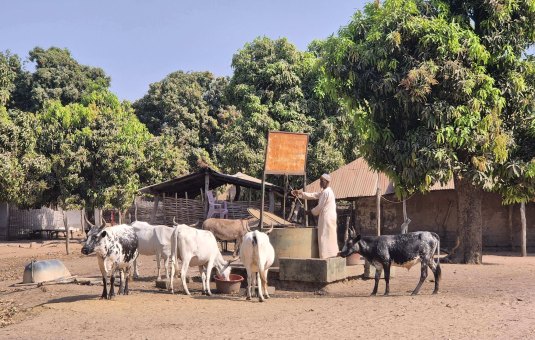
For Dauda, a member of a livestock breeders’ association in Bafatá, a phone call can mean that two neighbours are on the verge of a serious disagreement.
A herd has strayed into a cultivated field. Cattle have damaged a vegetable garden. A farmer, worried about losing a season’s work, has retaliated against the animals. Someone needs to intervene before a dispute escalates.
But reaching the people involved is not always straightforward. Communities can be far apart, and the people called on to mediate do not always have the money to get there.
“In most cases, people call us, but we can’t get to the site where the conflict is taking place because we might not have the money to buy fuel for our motorcycles. Fortunately, we have members in many communities. We call them, and they step in. They send us photos or videos of what’s happening,” Dauda explains.
His association has found a way to work around the distances. When one mediator cannot reach a village, another member closer to the dispute can step in, document what has happened and help the parties begin talking.
Sometimes, that conversation is enough to prevent a damaged crop from turning into a lasting rift. Farmers and herders can negotiate compensation and agree on how to avoid a repeat of the incident. The challenge is to find arrangements that protect both sides’ livelihoods.
Sharing land, negotiating the rules
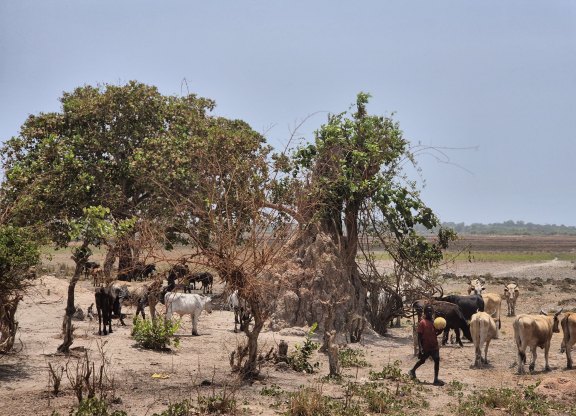
Across Guinea-Bissau’s eastern regions of Bafatá and Gabú, farmers and livestock breeders depend on the same land and water. Fields provide food and income; grazing routes allow herders to move their animals. When livestock enters cultivated land, or when access to resources becomes contested, the costs can fall on people who already have limited means to absorb a loss.
These disputes are often described as conflicts between farmers and herders. But the problem is also about how land is used, who can access it and how communities agree on the boundaries between different activities.
Land-use planning and local institutions can help establish those rules. Yet formal mechanisms may be difficult to reach in remote areas, leaving communities to manage disputes through their own networks. Those networks can be effective, but they need support if they are to respond consistently and help prevent tensions from escalating.
To understand what was driving the conflicts, UN-Habitat worked with livestock breeders’ associations Nague in Bafatá and Gaare Batoden in Gabú to establish community-based monitoring of incidents related to pastoralism and transhumance — the seasonal movement of livestock between grazing areas.
Between March 2025 and April 2026, the networks documented and analysed 338 incidents. The findings challenged the assumption that competition over agricultural land and seasonal livestock movements were the main drivers of conflict.
Cattle theft accounted for 42 per cent of reported incidents, while agricultural damage, including destroyed crops and livestock entering gardens, accounted for 34 per cent. The distinction matters: preventing disputes requires understanding what is actually happening in each community, rather than assuming that every incident has the same cause.
The monitoring also revealed differences in how disputes were resolved. In rural areas, community mediation achieved positive resolutions in approximately 70 per cent of cases, compared with 29 per cent in urban and peri-urban areas such as Gabú, where weaker social cohesion and delays in police investigations complicated resolution.
The figures offer a more detailed picture of where local mechanisms are working and where additional support may be needed. They also give authorities and community representatives evidence to guide their responses.
Bringing land governance closer to communities
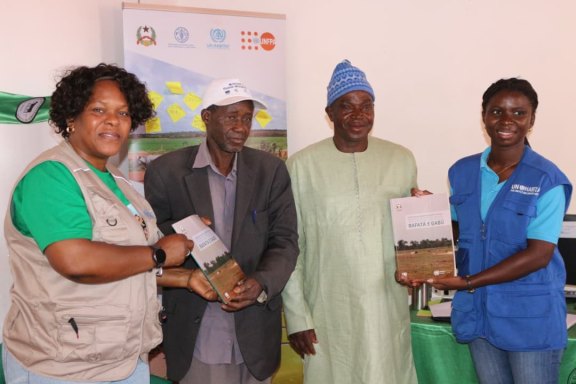
UN-Habitat’s project, Prevention of Natural Resources Conflicts related to Pastoralism and Transhumance in Bafatá and Gabú Region, combined community monitoring with efforts to strengthen local institutions and improve the management of shared resources.
One part of that work was the establishment of 13 Sectoral Land Commissions, extending the reach of Guinea-Bissau’s National Land Commission into remote communities. Bringing together local stakeholders, including livestock breeders’ associations, the commissions are intended to support conflict monitoring, mediation and prevention, while strengthening implementation of the country’s Land Law.
Their role is particularly important when communities need to agree on how land should be used. Measures such as demarcating cultivated areas and managing livestock movements can help reduce the risk of animals entering fields and gardens in the first place.
The project also invested in water infrastructure. Dedicated boreholes for livestock were installed separately from drinking water points intended for people, aiming to ease competition over limited water supplies while supporting safer drinking water and healthier living environments.
Between March 2025 and April 2026, the networks documented and analysed 338 incidents. The findings challenged the assumption that competition over agricultural land and seasonal livestock movements were the main drivers of conflict.
Cattle theft accounted for 42 per cent of reported incidents, while agricultural damage, including destroyed crops and livestock entering gardens, accounted for 34 per cent. The distinction matters: preventing disputes requires understanding what is actually happening in each community, rather than assuming that every incident has the same cause.
The monitoring also revealed differences in how disputes were resolved. In rural areas, community mediation achieved positive resolutions in approximately 70 per cent of cases, compared with 29 per cent in urban and peri-urban areas such as Gabú, where weaker social cohesion and delays in police investigations complicated resolution.
The figures offer a more detailed picture of where local mechanisms are working and where additional support may be needed. They also give authorities and community representatives evidence to guide their responses.
Building relationships
In Gabú, cooperation also extends beyond the immediate task of resolving disagreements. Members of the Gaare Batoden livestock breeders’ association use WhatsApp groups to share information about missing animals and help locate livestock found wandering alone.
“We communicate through WhatsApp groups. If a cow gets lost, it’s easy to find it. We send each other photos of cows or goats we find wandering alone. Then we exchange them,” explains Isnaba, a member of the association.
The groups provide a practical way to exchange information across communities and national borders. They can also help prevent misunderstandings by making it easier to establish where an animal belongs and contact its owner.
For Isnaba, building trust means working with people beyond the livestock-breeding community, too.
“We also collaborate with the women who are part of the peasants’ women associations here in the town of Gabú. We’re building relationships,” she explains.
That work may begin with a missing animal or a damaged garden, but its value extends further. When people know whom to call, can reach someone who will listen and have a way to negotiate a solution, a dispute does not have to become a lasting conflict.
In Bafatá and Gabú, sharing land depends on more than where one field ends and another begins. It also depends on the relationships, local institutions and agreed rules that allow people to make a living alongside one another.