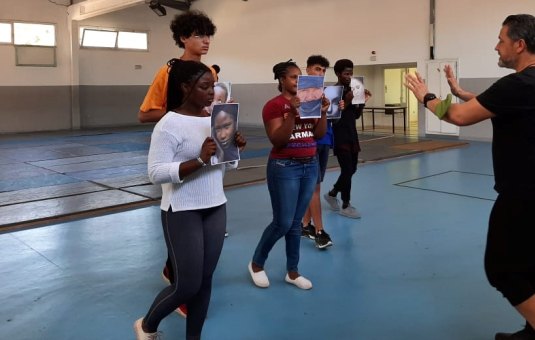
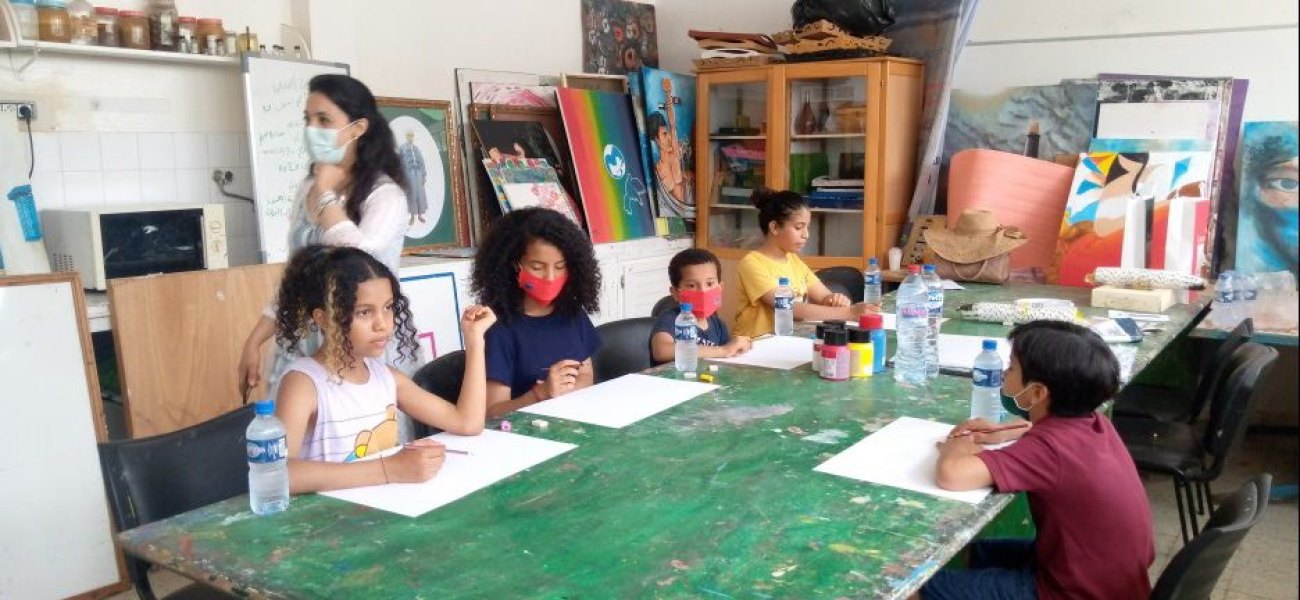
The choice of La Marsa’s gymnasium as one of the city’s artistic centres was an essential component of the UN-Habitat project Mediterranean City to City Migrations (MC2CM), implemented in partnership with the organisation Tunisie Terre d'Asile and funded through the European Union and Swiss cooperation.
The city of La Marsa has undergone major urban upheavals in recent years and has welcomed an increasing number of sub-Saharan migrants, including workers, students, and families with young children.
Those migrants have mostly settled in Bhar Lazreg, on the outskirts of La Marsa, a neighborhood that was until recently an agricultural area. Today, Bhar Lazreg is a residential area of 50,000 inhabitants in a peri-urban area and has experienced since 2011 a significant and anarchic urban development. It is marginalized geographically and socio-economically and, therefore, it is urgent to support local authorities in the management of urban and social development.
From the beginning of the MC2CM project last December, one focus of UN-Habitat was to choose an easily accessible location, in agreement with the La Marsa municipality, that could strategically address the underlying socio-economic intricacies of the relations between the host community and the migrants. It also required the participation of actors who understood cultural nuances and were willing to be adaptive to them.
According to Chiraz Gafsia, urban architect and project coordinator for the UN-Habitat Office in Tunisia, it is urgent to “break the social, economic, urban and environmental marginalization of the outskirts of La Marsa and to take into consideration its development by including all its social components as well as the growing migrant population.”
The issue, she said, “is global but solutions at the local level are essential, especially in the context of the ongoing decentralisation and anticipate future developments.”
Zouhour Grira, head of the district of Bhar Lazreg and one of UN-Habitat’s municipal counterparts in the project, agrees.
"It is necessary to provide innovative solutions for social and urban inclusion of Bhar Lazrag in La Marsa. It is necessary to find inclusive, ecological, and sustainable solutions to bring within Bhar Lazreg while preserving and creating a link with the centre of the city.”
UN-Habitat, “using its participatory approach through this project to create artistic content and awareness against racism through joint workshops is taking a step towards improving the future of our city and its sustainability,” she added.