Strategic plan
2026-2029
Cards of contacts
Anacláudia Rossbach
We are living through a global housing crisis. Out of every eight persons today, at least three do not have access to adequate housing, and out of every four persons, at least one is living in an informal settlement or slum, and hundreds of millions live homeless. In this context, far too many people in our world are deprived of dignity, safety, stability, and opportunity. Without action, this crisis will inevitably undermine efforts to deliver global development agendas today and tomorrow.
That is why, at UN-Habitat, we are going back to the basics. Since UN-Habitat’s establishment, housing has been at the core of our mandate. Over five decades, we have developed deep expertise and knowledge on housing, while also leading the delivery of impact in countries across all regions. Building on this, our strategic plan 2026-2029 has a central focus on housing, land and basic services as essential enablers for sustainable cities and communities. Unless we address gaps in these areas,it is not possible to tackle key global challenges including poverty, climate change and humanitarian crises.
Process of development of the strategic plan for the period 2026–2029
- In decision 2/1, adopted by the United Nations Habitat Assembly of the United Nations Human Settlements Programme (UN-Habitat Assembly) at its second session, in order to promote policy coherence across the United Nations system, Member States committed to the alignment of the strategic planning process of UN-Habitat with the cycle of the quadrennial comprehensive policy review of operational activities for development of the United Nations system. In its decision 2/2, the Assembly adjourned its second session, to be resumed on 29 and 30 May 2025, with the consideration of the strategic plan for the period 2026−2029 on the provisional agenda.
- The preparatory process included elements that sequentially, incrementally and iteratively articulate the development of the strategic plan and was carried out in consultation with Member States and in line with their guidance. The key stages of the process of developing the strategic plan were:
- Guiding principles, definition of purposes and approach, and other preliminary considerations;
- Key elements of the substantive framework: global challenges, strategic focus in the context of the vision for the period 2026–2029, impact areas and means of implementation;
- Planned results: impact on people’s lives and outcomes for key actors and stakeholders in the process;
- Principles for coherent implementation, monitoring performance and selecting indicators.
- The preparation of the draft strategic plan for the period 2026–2029 (see annex) was informed by the 2030 Agenda for Sustainable Development, the New Urban Agenda and resolutions of the UN Habitat Assembly.
- Four retreats of the Member States were organized by the Executive Director for the development of the draft strategic plan of UN-Habitat for the period 2026–2029 in order to present progress and to solicit guidance from Member States. The retreats were devoted to the following topics:
- Proposed guiding principles (31 January 2024);
- Priorities and goals to be included in the strategic plan (30 May 2024);
- Draft annotated outline containing the proposed key elements of the substantive framework, the proposed hierarchy of planned results and examples of the proposed formulation of impact and outputs (16 September 2024);
- Proposed outcomes, implementation guidance and monitoring of implementation performance for the strategic plan (15 January 2025).
- Consultations on the development of the strategic plan were conducted at the meetings of the ad hoc working group on programmatic, budgetary and administrative matters on 11 March, 8 April, 3 July and 13 November 2024, and on 10, 17 and 24 February and 5 March 2025.
- The Executive Director held retreats and consultations with staff members on the development of the strategic plan on 15 and 16 April, 19 August and 28 August 2024, and on 14 January 2025.
- Consultations on the alignment of the strategic plan with the plans of other United Nations development system entities were conducted during the twelfth session of the World Urban Forum, held in Cairo from 4 to 8 November 2024, and at the annual meeting of the United Nations Strategic Planning Network held in Rome from 19 to 21 November 2024.
- Consultations with stakeholders and partners, including civil society, professional associations and academia, were held at the twelfth session of the World Urban Forum through a dedicated session and digital feedback mechanisms for participants.
Our means of implementation and expected outcomes
Spatial development plans, policies and legislation, planning systems and finance frameworks foster the social and ecological functions of land and catalyse public and private investments for access to adequate housing, land and basic services for all.
Participatory multilevel governance mechanisms support access to adequate housing, land and basic services for all and the mainstreaming and achievement of gender equality and the empowerment of women and girls, and accelerate the localization of the Sustainable Development Goals.
Improved knowledge and capacities inform evidence-based, innovative policies on access to adequate housing, land and basic services for all.
Driven by this strategic focus, the improvement of people’s lives in all impact areas will be pursued through five means of implementation, which enable UN-Habitat to seek impact through expected outcomes, as set out in the table below.
Increased and predictable resources for UN-Habitat and its partners advance access to adequate housing, land and basic services for all.
Global challenges to be addressed
Given its magnitude and urgency, the global housing crisis is the main challenge to which the proposed strategic plan for the period 2026–2029 responds. An estimated 2.8 billion people worldwide are affected by different forms of housing inadequacy. This number is expected to grow due to population growth, increasing urbanization, forced displacement and economic pressures, among other drivers. The pandemic and inflation have caused the worst housing affordability crisis in more than a decade. The International Monetary Fund housing affordability index shows that affordability has deteriorated in developed countries in the past decade. Affordability tends to be lower and more volatile in developing countries and emerging markets, in part reflecting their less developed regulatory and financial frameworks and markets. This phenomenon increases inequality in many societies. The plight of 1.1 billion people living in informal settlements and slums and more than 300 million homeless people calls for urgent and effective collective action.
As recognized by the UN-Habitat Assembly in its resolution 2/7, the right to adequate housing, derived from the right to an adequate standard of living, is not realized for many throughout the world, and in most countries the disparity between housing costs and income levels has grown while access to finance is constrained, thus making adequate housing unaffordable to many people.
The global housing crisis must be seen in a broader context of poverty and inequality. As of 2023, more than 700 million people – roughly 9 per cent of the global population – still lived below the international extreme poverty line of less than $2.15 a day, while moderate poverty, affecting those living on less than $3.65 a day, impacted more than 1.8 billion people worldwide. A significant proportion of global poverty is found in urban areas, especially when a higher poverty threshold of $6.85 a day is applied.While urban areas generate 80 per cent of the world’s gross domestic product, the resulting economic benefits are not evenly distributed.
This crisis is compounded by the accelerating impact of climate change, which could force an estimated 216 million people to migrate within their own countries by 2050 due to rising sea levels, extremeweather events and other climate-related factors.Cities bear the brunt of climate exposure, as 92 per cent of people settled in low-elevation coastal zones live in urban centres. More than 2 billion people currently living in cities could be exposed to an additional temperature increase of at least 0.5 degrees Celsius by 2040. Informal settlements, often located in environmentally sensitive areas, experience the harshest impacts of climate change but have the least capacity to recover.
Cities generate 70 per cent of greenhouse gas emissions and more than 2 billion tons of waste annually. Furthermore, 99 per cent of the world’s urban population lives in areas that do not meet the new World Health Organization guidelines on air quality. The loss of biodiversity – with around one million species at risk of extinction – further threatens the sustainability of ecosystems that support urban and rural livelihoods. Urban sprawl, driven mainly by unsustainable consumption of land for housing, led to a 2.5 per cent decline in urban population densities globally from 2000 to 2020, which has further exacerbated the erosion of biodiversity and ecosystems while increasing spatial inequalities.
There is a growing convergence of crises impacting urban areas. Urban centres worldwide, especially in developing countries, often have characteristics that make them and their inhabitants especially vulnerable to the adverse impacts of climate change and other natural and human-made hazards, including earthquakes, extreme weather events, flooding, coastal erosion, subsidence, storms (including dust and sand storms), heatwaves, water scarcity, desertification and droughts, water and air pollution, vector-borne diseases and sea level rise. By 2050, climate change may force up to 158 million more women and girls into extreme poverty, million more than men and boys. Disasters cause $300 billion in damage to infrastructure globally each year, with cities accounting for a significant portion of this loss. The effects of disasters exacerbate existing inequalities and place immense pressure on urban systems, particularly in informal settlements, where infrastructure is often poor.
The growing prevalence of conflict has displaced over 100 million people, causing severe hardship for refugees and internally displaced persons. It has worsened land and housing shortages and strained efforts to create stable living environments, as more than 60 per cent of displaced persons seek refuge, livelihood opportunities and access to services in cities and human settlements, often disrupting social cohesion and fuelling informality when migration is unmanaged.
Description
As of 2023, more than 700 million people – roughly 9 per cent of the global population – still lived below the international extreme poverty line of less than $2.15 a day, while moderate poverty, affecting those living on less than $3.65 a day, impacted more than 1.8 billion people worldwide.
UN-Habitat’s mandate and our role in addressing the challenges
Description
As repeatedly acknowledged at the United Nations Conferences on Human Settlements and on Housing and Sustainable Urban Development, notably in the Vancouver Declaration on Human Settlements (1976), the Habitat Agenda (1996) and the New Urban Agenda (2016), effective human settlement strategies are essential for promoting inclusion, social equity and economic growth, and human settlements are inseparable from national development. The transformative potential of urbanization lies in its ability to address spatial and social inequality, foster economic opportunities for all, create access to essential services, including digital ones, on the basis of people-centred and inclusive approaches, and build resilient communities across the rural-urban continuum. Specifically, for the period 2026–2029, UN-Habitat will focus on the tremendous opportunity to address the aforementioned challenges through access to adequate housing, land and basic services for all and through the transformation of informal settlements and slums.
The mandate of UN-Habitat was articulated by the General Assembly when mandating the United Nations Conference on Housing and Sustainable Urban Development and when adopting its outcomes in 2016, reaffirming the role and expertise of UN-Habitat as a focal point for housing and sustainable urban development within the United Nationssystem. With 55 per cent of the global population living in urban areas, a figure that is projected to rise to 68 per cent by 2050, UN-Habitat’s mandate is more critical than ever as the attainment of global development outcomes becomes increasingly tied to how we plan, build, manage and govern our cities and human settlements.
Urbanization presents both a challenge and a significant opportunity for achieving sustainable development. When guided by proper spatial planning and managed and developed sustainably, cities and human settlements – along with their systems – can drive innovative solutions to address housing shortages and provide access to land and basic services, taking the territorial dimension of sustainable development into account. To achieve economic transformation for advancing the potential of countries to conceive and implement sustainable urban and territorial development policies, all territorial scales need adequate physical and digital infrastructure and effective institutions that underpinproductive and equitable economies, leaving no one behind.
Against this background, UN-Habitat will work to guide and promote strategic planning, synergetic investment and coherent implementation to prevent urbanization from exacerbating existing inequalities, overburdening infrastructure and increasing vulnerabilities to climate and environmental risks. Therefore, in the period 2026–2029, UN-Habitat will support Member States in adopting sustainable, people-centred and integrated approaches to urban and territorial development by implementing policies, strategies, capacity development initiatives and actions at all levels, supporting territorial systems that integrate urban and rural functions into sustainable national and subnational spatial frameworks and systems of cities and human settlements. This will also include promoting integrated, polycentric and balanced territorial development policies and plans.
While other entities in the United Nations system play a leading role in addressing specific global challenges related to poverty eradication, crises emerging from climate change, disasters and conflict, and the environment, UN-Habitat makes a unique contribution to addressing the urban and territorial dimensions of these global challenges by providing guidance and support to Member States and other actors on harnessing the transformative potential of sustainable urbanization, leveraging the critical role of adequate housing and addressing the urgent issue of informal settlements and slums. This contribution is guided by the United Nations system-wide strategy on sustainable urban development, which was welcomed by the General Assembly in resolution 77/173 and defines the role of UN-Habitat in the promotion of sustainable urban development within the United Nations system through a collaborative implementation framework, building on existing structures and processes.
UN-Habitat continues to partner with United Nations entities at various scales to advance the New Urban Agenda and Sustainable Development Goal 11, as well as the targets of other Sustainable Development Goals that include urban dimensions. At the global level, UN-Habitat collaborates within the United Nations system as a partner and contributor to legislative and inter-agency mechanisms, as well as in the follow-up to and review of global agendas and action frameworks, including the Pact for the Future, adopted by the General Assembly in resolution 79/1. At the regional level, UN-Habitat actively coordinates with United Nations actors through established mechanisms such as the regional sustainable development forums and the regional collaborative platforms, At the national and subnational levels, UN-Habitat participates in United Nations country teams and contributes to United Nations Sustainable Development Cooperation Frameworks to support the urban dimension of national development priorities.
Guided by the New Urban Agenda and the Sustainable Development Goals, UN-Habitat’s approach is people-centred and anchored in international human rights law. This ensures that urban development prioritizes inclusivity, equality, non-discrimination and resilience, preventing inequality and exclusion, which undermine the sustainability of cities and human settlements. Without this approach, urban growth runs the risk of perpetuating inequality and exclusion, further undermining the sustainability of cities and human settlements and the well-being of their inhabitants, in particular those in vulnerable situations.
Our strategic focus in addressing the challenges
Addressing the global housing crisis and challenges related to poverty, climate change and humanitarian crises is key to ensuring that cities and human settlements evolve into sustainable, equitable and resilient spaces and communities where no one is left behind. Analysing challenges and opportunities within the broader context of sustainable urban and territorial development, UN-Habitat will focus on the opportunity to address the global challenges set out above through access to adequate housing, land and basic services for all, including the transformation of informal settlements and slums.
This focus will maximize the value added by UN-Habitat from 2026 to 2029. Building on UN-Habitat resolutions 2/7 on adequate housing for all and 2/2 on accelerating the transformation of informal settlements and slums by 2030, as well as on action 6 of the Pact for the Future, it returns housing to the centre of UN-Habitat’s work and sustainable urban development.
Access to adequate housing, as a fundamental human right, in all seven of its aspects (see figure II) is a cornerstone of a new social contract and is crucial to fostering inclusive, sustainable and equitable development. Due to its multifaceted and cross-sectoral nature, adequate housing has shown its potential as the engine of inclusive and sustainable urbanization with linkages to most of the other Sustainable Development Goals (see figure III), in particular Goal 1 (End poverty in all its forms everywhere), Goal 10 (Reduce inequality within and among countries), and Goal 5 (Achieve gender equality and empower all women and girls). Many of the Goals cannot be achieved if people do not have adequate housing.
The New Urban Agenda elevates housing as a fundamental means of enabling economic development and poverty eradication. Housing is most importantly about providing good-quality homes for all, with all the associated social and economic benefits, and should not be viewed as a mere matter of physical structures or as a commodity to be bought and sold. Adequate housing is essential for health, education, dignity, safety and social inclusion, as recognized in earlier global frameworks, including the Istanbul Declaration and the Habitat Agenda of 1996.
Similarly, the important social and ecological functions of land and its economic value must be emphasized from a public goods perspective. Proximity to and socioeconomic accessibility of public facilities and basic services are at the heart of adequate housing, which itself underpins secure access to services, employment and urban life, thus enhancing social cohesion, well-being, and quality of life, which require well-functioning cities and human settlements. The prioritization of implementing the right to adequate housing in local, national and global frameworks is key to ensuring dignity and empowerment for all and as a pillar of social protection. Affordability of housing and access to basic services are universally important, even if the means of improving them might differ in developed and developing countries because of differences in economic structures, institutional capacity and available resources.
The transformation of informal settlements and slums, which in 2022 housed 24.8 per cent of the global urban population, equivalent to 1.12 billion people, is equally vital yet even more urgent. This figure is expected to reach 3 billion by 2050 if no effective action is taken to prevent the proliferation of slums and informal settlements and transform the existing ones. As acknowledged by Member States, Sustainable Development Goal indicator 11.1.1 – the proportion of urban population living in slums, informal settlements or inadequate housing – is one of nine indicators which have regressed globally, highlighting the need for more concerted efforts to meet the target by 2030. Slum dwellers are members of our communities who should enjoy equal rights and dignity and who play important cultural, economic and social roles.
The strategic focus on access to adequate housing, land and basic services for all aligns with the core areas of the UN-Habitat mandate and its unique position as a United Nations system focal point for adequate housing and sustainable urbanization and human settlements
Figure II: The seven aspects of adequate housing

Figure III: Housing at the centre of sustainable and inclusive development

Impact areas to address the challenges
The expected global impact is that more people in cities and human settlements, in particular those in vulnerable situations, including people living in informal settlements and slums and those affected by humanitarian crises and climate impacts, will prosper and have their lives transformed through increased access to adequate housing, land and basic services for all.
The impact areas set out below mirror the key challenges that global society faces. Through its strategic focus and in the context of sustainable urbanization, UN-Habitat aims to contribute to the efforts of other multilateral actors, including United Nations entities leading in these areas, to achieve an impact on people’s lives in these domains
Description
A. Equitable and inclusive prosperity for poverty eradication
A more prosperous and inclusive society is fostered by properly planned and managed urbanization and the sustainable development of cities and human settlements. This is achieved by developing infrastructure and institutions that support social inclusion, reduced inequalities and equitable economic growth, and by creating more decent jobs in the formal economy for all.
Adequate housing, aside from being a precursor to other essential aspects of social inclusion, such as education and health, also serves as an asset in creating livelihood opportunities. Well-located, well-connected and appropriately densified mixed- use and socially mixed neighbourhoods enable equitable access to services and opportunities for all. Well-designed networks of accessible, green and high-quality public spaces, accessible to all and free of crime, sexual harassment and gender-based violence – in view of the urgent need to prevent and eliminate all forms of violence and harassment against women and girls – along withsafe, equitable, affordable and accessible mobility systems, are key to promoting inclusive prosperity. These interventions help to eradicate poverty, recognizing the specific needs of those in vulnerable situations, to achieve gender equality and to empower all women and girls.
Access to adequate housing, land and basic services is essential to laying the groundwork for a society in which everyone can thrive. When this nexus is strong and functional and leaves no one behind, it also prevents the proliferation of informal settlements and slums and reinforces their transformation. The housing sector touches most aspects of a country’s economy and interacts with many other sectors, including industry, trade, technology, finance, transport and social development. Recognizing the social function of land is central to guiding and financing sustainable urban development. Equitable access to basic services, underpinned by strategic planning and effective implementation, is the basis of sustainable communities and sound economic development. It thus plays a major role in enabling inclusive economic growth and prosperity to eradicate poverty and reduce inequalities. The provision of services is eminently dependent on adequate infrastructure investments and can only be achieved effectively and equitably in well-planned and appropriately dense settlements.
The role of UN-Habitat in addressing this impact area is to promote equitable and inclusive prosperity for poverty eradication through robust data, policies and practices for better access to adequate housing, land and basic services. UN-Habitat promotes the efficient and equitable use of land to deliver sustainable urban development, including adequate housing, and to maximize the security of tenure with a view to ensuring the social and economic benefits that it provides, including the protection of dignity. UN-Habitat supports Member States in achieving access to adequate housing for all by promoting effective land governance and management and the provision of adequate basic services. This contributes to harnessing the potential of urbanization to foster more inclusive prosperity, overcome existing spatial and social inequalities across the rural-urban continuum, and transform the lives of people living in informal settlements and slums.
The expertise of UN-Habitat encompasses an integrated approach to urban and territorial planning, ensuring that access to housing, land and basic services is addressed holistically in order to advance equitable prosperity and poverty eradication. In line with UN-Habitat Assembly resolution 2/8 on urban planning and sustainable infrastructure,40 UN-Habitat provides technical assistance and capacity-building support to countries, cities and other stakeholders in developing and implementing participatory and sustainable integrated urban planning and infrastructure development initiatives.
B. Preparedness, response, recovery and reconstruction
A shared understanding of the complex impact of converging crises on cities, human settlements, their communities, and territories can guide more effective preparedness, response and recovery, with particular attention to those who are most affected by natural and human-caused disasters and conflict, leading to reconstruction to “build back better” and strengthening resilience.
A more cohesive response to displacement, when fully integrated into urban and territorial development strategies, can advance solutions from the start during the humanitarian response. Addressing access to adequate housing, land and basic services can provide a framework for a more integrated response with all actors involved, using urban and territorial planning and multilevel governance to localize and enable solutions for migrants, refugees and internally displaced people.
Improved risk assessment and foresight can help in anticipating and preparing for the impact of crises on cities, human settlements and territories, thus strengthening mitigation and resilience. Working across the whole cycle of preparedness, response, recovery and reconstruction allows UN-Habitat to help integrate humanitarian and development efforts and leverage its comparative advantages, as called for by the General Assembly in its resolution 79/226 on the quadrennial comprehensive policy review of operational activities for development of the United Nations system, adopted in 2024.41 As recalled by the UN-Habitat Assembly in its resolution 2/9 on the creation of a human settlements resilience framework for early warning, foresight, risk reduction, crisis response, and post-crisis recovery and reconstruction, UN-Habitat plays a leading role in assisting national, regional, and local governments in these areas.
As a member of the Inter-Agency Standing Committee, UN-Habitat helps the humanitariansystem to adapt its response to the increasingly urban nature of crisis. These activities include the following: promoting settlements-based approaches to inform preparedness and support contextualized local coordination and more integrated response; empowering local governments and community-based organizations to help localize humanitarian interventions; helping to restore basic services at the community level; and ensuring a focus on access to adequate housing, land and property rights to protect the people affected. These efforts make the humanitarian response more effective, reducing the humanitarian caseload and accelerating the transition to recovery whenever and wherever possible.
Description
Improved risk assessment and foresight can help in anticipating and preparing for the impact of crises on cities, human settlements and territories, thus strengthening mitigation and resilience.
Description
C. Environment and climate action
The interlinkages between climate change, environmental degradation and the current global housing crisis create obstacles to effective climate adaptation and mitigation. Housing and infrastructure provision that encourages urban sprawl and increased reliance on motorized transport lead to traffic congestion and declining green cover, and exacerbate air pollution, with detrimental effects on human health, the environment and climate change mitigation. A deficit of adequate housing aggravates the human cost of weather-related disasters and can hinder adaptation to the environmental effects of climate change, as well as those of other challenges, such as drought and desertification, land degradation, wildfires, pollution and floods, and coastal erosion on people in vulnerable situations, especially in informal settlements and slums.
Well-managed urbanization and improved access to adequate housing, including through urban and land-use planning and design, are essential in addressing the causes and impacts of climate change in cities and human settlements at all scales across the urban-rural continuum. Digital technologies help to improve resource efficiency, including in smart grids, waste management monitoring, climate monitoring and other areas. A shift towards a circular model in the building and construction sector and the use of sustainable building materials is urgently needed in order to reduce the carbon imprint of construction.
Urban planning and management that ensure adequate densities, green space retention and expansion, and the promotion of nature-based solutions offer potential for urban heat mitigation, flood risk reduction, biodiversity preservation, enhanced human well-being, quality of life, and socioeconomic co-benefits. Energy-saving infrastructure and effective waste management are critical for both climate change mitigation and sound economic development. In addition, due regard must be given to the importance of preserving architectural heritage while respecting the specificities of each region and strengthening efforts to protect and safeguard the world’s cultural and natural heritage
Strengthening resilience to climate-related hazards through risk-sensitive urban and land-use planning, building codes applied to housing, and resilient infrastructure that provides access to adequate housing, land and basic services – especially for those in vulnerable situations – must be at the core of efforts to adapt to global climate change.
In the area of environment and climate action, UN-Habitat adds value to the efforts of other actors in the multilateral system by supporting their work through the lens of people-centred urban planning and mainstreaming biodiversity and ecosystem services into urban and territorial planning and management, as requested by the UN-Habitat Assembly in resolution 2/4 on biodiverse and resilient cities. In addition, UN-Habitat enriches the efforts of the United Nations system by addressing the urban and territorial dimensions of key issues, such as water resource planning and management across the rural-urban continuum.
The value added by UN-Habitat includes support for subnational authorities, which play a key role in implementing policies to adapt to climate change and mitigate its effects, including through risk assessments and early warning systems. To scale up impact in cooperation with relevant partners, as requested in UN-Habitat Assembly resolution 2/5 on enhancing the interlinkage between urbanization and climate change resilience,46 UN-Habitat must continue efforts to support Member States and other key actors in productively leveraging this connection.
J. Miller

Our means of implementation and expected outcomes
The means of implementation are instruments for seeking outcomes that jointly support the attainment of global impact through the strategic focus on access to adequate housing, land and basic services for all. Two substantive and three supportive means of implementation have been formulated in the proposed strategic plan. In order to be effective and efficient, they must be used coherently in both horizontal collaboration (across the means of implementation) and vertical collaboration (between headquarters and the field).
Outcomes constitute a distinct level in the hierarchy of the results chain:
- Impact at the top, where we have only indirect influence: what occurs in people’s lives;
- Outcomes in the middle, where we have more direct influence: what we help our partners to do better;
- Outputs at the bottom, where we have full control: deliverables of our work.
- The hierarchy of results set out above will be monitored through corresponding levels of indicators.
In all means of implementation, special attention will be given to eliminating all forms of racial discrimination and empowering women, children, young people, older persons and persons with disabilities, Indigenous Peoples and local communities, refugees, internally displaced persons and migrants, in particular the poorest and those in vulnerable situations who are disproportionally affected by the global housing crisis and other urbanization-related hardships.
A. Integrated urban and territorial planning, management, investment and finance
Outcome: Spatial development plans, policies and legislation, planning systems and finance frameworks foster the social and ecological functions of land and catalyse public and private investments for access to adequate housing, land and basic services for all.
An integrated approach to urban planning and infrastructure development is central to promoting sustainable development and achieving the Sustainable Development Goals. Long-term urban and territorial planning and design underpin the delivery of positive outcomes of urbanization across social, economic and ecological dimensions, as envisioned in the New Urban Agenda, and is key to providing adequate housing, land and basic services.
Effective urban planning is the backbone of delivering inclusion, resilience, accessibility and sustainability in cities and communities. Integrated land-use planning and management are fundamental to opening the fiscal space of national and local governments through stable local revenues, especially from land-based finance, in order to maximize the social and economic functions of land. Such planning and management can be enhanced through smart city solutions, such as digital platforms for citizen engagement in planning processes, real-time data analysis for optimizing land use, and online portals for efficient urban planning, management and governance.
At the national level, given the significant impacts of urbanization on development, spatial planning is vital for improving the strategic prioritization and sequencing of investments in coherent territorial development across the rural-urban continuum. This is essential for guiding and implementing local development plans and achieving their targets, with housing interventions embedded within broader spatial development strategies that integrate urban,peri-urban and rural systems to ensure balanced and sustainable territorial development.
UN-Habitat will provide normative guidance and technical assistance to Member States and other partners on participatory, inclusive, sustainable, integrated and evidence-based urban planning and infrastructure development in order to improve the capacity of all levels of government to coherently plan, manage and implement productive, equitable, inclusive and environmentally sustainable urban development. This includes planning for urban densification and urban extension, renewal and regeneration, with public open green spaces and other basic services and efficient and accessible public transport systems that are safe, affordable, accessible, sustainable and efficient and include non-motorized mobility in alignment with the Global Plan for the Decade of Action for Road Safety 2021–2030. UN-Habitat will promote spatial planning for cohesive economic development and public investment at all scales, strengthening environmentally sensitive economic productivity and social inclusion in cities, human settlements and territories across the urban-rural continuum, seeking to decrease disparities in living conditions in rural and urban areas, and supporting local and regional governments in developing urban plans that incorporate zoning and regulatory mechanisms to increase the supply of affordable housing.
The implementation of these plans should be backed by territorially coherent investment and well-coordinated finance at all levels of governance, anchored in a strategic approach that prioritizes the deployment of resources through spatially informed capital investment planning and municipal and national finance strategies. Acknowledging the different roles of specific finance sources and instruments, leveraging enhanced own-source revenues and ensuring adequate sharing of the value created by urban development and public investments are critical to ensuring sustainable urban financing and achieving inclusive urban prosperity. UN-Habitat will support Member States in the design and review of financial instruments, such as fiscal policies and land-based finance mechanisms, to align financial and urban frameworks.
B. Participatory multilevel governance and localization of the Sustainable Development Goals
Outcome: Participatory multilevel governance mechanisms support access to adequate housing, land and basic services for all and the mainstreaming and achievement of gender equality and the empowerment of women and girls, and accelerate the localization of the Sustainable Development Goals. The Sustainable Development Goals must be met for all segments of society, leaving no one behind, including through the localization of sustainable development. Transforming the global goals into long-lasting change at the local level and the collective pursuit of more inclusive, sustainable and resilient cities and human settlements require effective localization processes that foster alignment between national frameworks and communities’ priorities.
The capacities of national and local governments to create enabling environments for sustainable development anchored in multilevel governance and policy coherence are essential. These environments must focus on advancing the transformation of cities for social progress, shared prosperity and environmental protection. Localization of the Sustainable Development Goals is a collaborative and impact-oriented approach to transforming governance systems through partnership and coordination, enabling the effective local achievement of the Goals to meet the needs of cities and local communities.
UN-Habitat has been requested by the Member States to promote the localization of the Sustainable Development Goals. Making use of the localization approach, the Programme will leverage its leadership and expertise on sustainable urbanization, qualitative and quantitative data, planning, capacity-building and finance, as well as other tools, to promote city-level transformation by building robust multilevel governance systems that serve the attainment of the Goals.
UN-Habitat will work across scales and with platforms, networks, communities of practice and coalitions of cities, local and regional governments and authorities to connect local and Indigenous knowledge, innovations and partners with relevant global dialogues and decision-making processes while offering a convening space for partnership-building and joint action for the Sustainable Development Goals.
C. Knowledge, data, digitalization and capacity development
Outcome: Improved knowledge and capacities inform evidence-based, innovative policies on access to adequate housing, land and basic services for all.
In its resolutions, the UN-Habitat Assembly has recognized and called for improvements in data collection on and the monitoring of sustainable urbanization. It is urgent to leverage digital technology and smart city approaches to improve data collection, analysis, and decision-making for better quality of life in cities and human settlements, while managing the associated risks to ensure an inclusive, open, sustainable, fair, safe and secure digital future for all. Participatory methods, geospatial tools, data platforms for modelling, training and research partnerships, and digital twin technology are crucial in ensuring that data reflect the lived realities of diverse communities, thereby supporting more inclusive and equitable urban planning. Disaggregated localized data are a tool for empowering communities while enriching the evidence base for monitoring urbanization.
To support effective evidence-based policy formulation and implementation to advance sustainable urban development, UN-Habitat will continue to undertake and lead the global monitoring of Sustainable Development Goal 11, the New Urban Agenda and the territorial dimensions of other Sustainable Development Goals. It will also continue to provide technical support to Member States and other stakeholders in implementing and monitoring the New Urban Agenda.
UN-Habitat will continue to conduct evidence-based research on cities and human settlements across the rural-urban continuum and intelligence-gathering and data analytics to inform policymaking, with foresight playing a critical role in managing uncertainty and planning for effective policy action59 and community engagement. Stronger communities of practice will be promoted, joining the efforts of diverse researchers and practitioners to shape effective solutions for sustainable urban development.
UN-Habitat will reinvigorate and mainstream its capacity development efforts, building on well-studied practices and integrating normative and operational dimensions across the organization. Through contextualized capacity-building initiatives, UN-Habitat will support key actors in assessing and addressing the capacity gap to support the implementation and monitoring of and reporting on the New Urban Agenda and in building national and local capacity to develop and implement public policies and programmes commensurate to the resources available in countries, cities and human settlements. These activities are grounded in and geared towards action, seeking to ensure that knowledge development and practice inform one another.
UN-Habitat will support knowledge exchangeand cross-learning among countries to transfer knowledge and share successful experiences. The potential of digital technologies to accelerate sustainable urbanization will be promoted through a people-centred smart cities approach that fosters international cooperation and promotes academic research and educational initiatives. UN-Habitat will further strengthen its normative work by better integrating feedback between the global level and regions and countries.
E. Effective resource mobilization
Outcome: Increased and predictable resources for UN-Habitat and its partners advance access to adequate housing, land and basic services for all.
Achieving sustainable urban development requires mobilizing substantial financial resources to provide more adequate housing and sustainable infrastructure, including health, education, transport and mobility, energy, water and waste management, and digital services. Among the Sustainable Development Goals, Goal 11 faces significant funding shortfalls. Scaling up financing efforts is critical to achieving the targets for housing, public services and urban resilience, necessitating increased efforts to mobilize resources for sustainable urbanization.
Guided by the present strategic plan, UN-Habitat will mobilize greater, diversified and more predictable resources for its work, including the implementation of the resolutions adopted by the UN-Habitat Assembly.64 These efforts will draw on the United Nations funding compact and its commitments to mutual action by Member States and United Nations entities to support the achievement of the Sustainable Development Goals, and on United Nations system-wide strategies such as the system- wide strategy for water and sanitation
UN-Habitat will leverage its existing capacities and intelligence to manage and improve existing initiatives and mechanisms for resource mobilization aligned to Member States’ needs and priorities to broaden and deepen donor engagement while also scaling up partnerships with international financial institutions to leverage resources and expertise.
Through the programmatic means of implementation and their outcomes, resource mobilization will enable partners and key actors globally and locally to gain access to more resources to implement programmes delivering access to adequate housing, land and basic services for all on the ground, seeking the expected global impact as articulated above. The integrated approach to urban and territorial planning could, in the long term, lead to a more efficient use of public resources.
This engagement, in turn, will help the Member States to mobilize resources for their own urban and territorial action, especially in response to demand in developing countries and countries most in need. Beyond traditional donors, UN-Habitat will collaborate closely with multilateral development banks, international financial institutions and the private sector, leveraging its strategic focus to promote and advance sustainable urban development.
FIGURES
still lived below the international extreme poverty line of less than $2.15 a day (as of 2023)
living on less than $3.65 a day
may migrate within their own countries by 2050 due to rising sea levels, extreme weather events and other climate-related factors
currently living in cities could be exposed to an additional temperature increase of at least 0.5 degrees Celsius by 2040.
are generated by cities
Proposed implementation approach
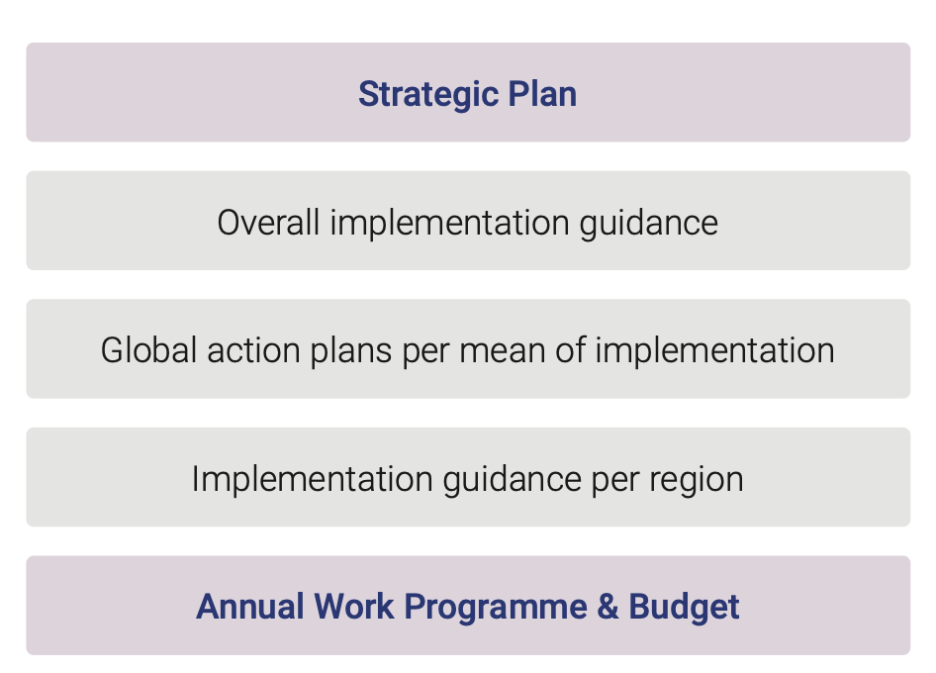
The overall implementation of the proposed strategic plan will be guided by a set of brief documents that form a bridge between the quadrennial strategic plan and the annual work programme and budget of UN-Habitat. Global action plans for each means of implementation will be developed in order to work towards expected outcomes, and adjustments of ongoing programmes will be made. Regional implementation guidance will also be developed with a view to tailoring the outcomes to specific contexts.
Description
Three goals will be set for implementation mechanisms:
- Ensure horizontal coherence and collaboration across all five means of implementation by gearing all work towards supporting the strategic focus. This includes seeking alignment and integrated delivery through the global programmes and initiatives to integrate the means of implementation across normative and operational pillars;
- Ensure symbiotic vertical coherence between headquarters and field operations. To that end, global programmes and services will work with country- and regional-level field projects managed by country offices to promote the strategic focus. While supporting regional and country operations with relevant knowledge and expertise, headquarters will harvest new and contextualized knowledge. This constant feedback loop will enhance expertise and serve as a means of interregional knowledge exchange;
- Prioritize, encourage and support collaboration with other United Nations entities and the broader multilateral system where the strategic focus adds value in the three impact areas. This will primarily ensure the overall impact in the three impact areas in coordination with the United Nations system entities leading in those areas.
Description
The annual work programme and budget is the only statutory document for implementing the strategic plan. It is structured according to subprogrammes and their results, which build on the key elements and results chain of the strategic plan. The implementation documents (see figure IV) are proposed with the purpose of bridging the strategic plan and the annual work programme and budget of UN-Habitat so that they are fully aligned.
Implementation will be carried out through joint actions of Member States, the secretariat of UN-Habitat and their partners, directed by the focus on access to adequate housing, land and basic services for all, and in accordance with the proposed strategic plan and its implementation guidance while ensuring that the normative and operational activities are balanced, that the normative work of UN-Habitat guides and is integrated into its operational work and that its experiences in the operational field feed into its normative work. In their work on the first two outcomes, headquarters and the regional and field offices will respond to the needs of the partner countries, devising context-specific intervention tools, while the pursuit of the other three outcomes will be guided by headquarters, using input and lessons learned from the field and collaborating with the regional and country offices.
The documents guiding implementation will direct collaboration across the means of implementation and the normative and operational work of the Programme, and they will outline the coordination of collaboration in pursuing the strategic focus for achieving global impact and define how the responsibilities for outcomes under individual means of implementation will be assigned to ensure accountability, transparency and effectiveness. The responsibilities for individual means of implementation and related outcomes, including for horizontal and vertical collaboration, will be assigned, as appropriate, at headquarters and the regional offices, with the Executive Director being responsible for horizontal and vertical coordination and coherence. These responsibilities will be supported by organizational and resource alignment in order to ensure integration and coherence so that accountability mechanisms can be established.
Monitoring implementation
Description
A robust monitoring framework is essential for measuring progress and assessing the impact of the strategic plan. This process responds to the challenges identified in the midterm evaluation by the Office of Internal Oversight Services of the strategic plan for the period 2020–2025. The framework will:
- Draw on lessons learned from previous monitoring practice;
- Ensure coherence between global goals and organizational efforts;
- Build on existing indicators and performance measures while developing new ones;
- Take into account UN-Habitat’s capacity for data collection, analysis and monitoring;
- Use insights from monitoring practices from other entities within the United Nations system.
The overall objective is to define an effective monitoring framework that allows UN-Habitat to measure and report on the results and impact achieved through the implementation of its strategic plan for the period 2026–2029. The specific objectives of the monitoring framework are:
- To define the principles underlying the approach to monitoring implementation of the strategic plan;
- To identify the specific methodologies that will be applied in monitoring implementation;
- To inform the design, implementation and monitoring of UN-Habitat’s normative and operational initiatives.
Description
During the process of elaborating the monitoring framework, the following will be considered:
- All indicators will be defined in such a way as to assess progress in line with the strategic focus on access to adequate housing, land and basic services for all, and the transformation of informal settlements and slums;
- A collaborative approach is needed, as the engagement and support of Member States and partners will be essential for generating and collecting accurate data. Through structured consultations, capacity-building initiatives and mechanisms to share data and best practices, Member States will play a crucial role in filling data gaps, refining methodologies and advancing evidence-based decision-making at both the regional and global levels. Recognizing challenges related to the availability of adequate, harmonized or recent data, partnerships with relevant institutions and actors will be critical to reporting on progress in implementing the strategic plan;
- While the preference is to focus on available data, new indicators and data collection methods will be required, including surveys and other tools. To this end, multiple data sources will be needed, including data and information from the Member States, the secretariat and partners;
- The monitoring approach will need to strengthen coherence across and leverage existing UN-Habitat initiatives and intergovernmental processes. For example, the monitoring of housing is closely associated with the work of the Open-ended Intergovernmental Expert Working Group on Housing for All, which may provide opportunities to advance data collection and availability;
- Given the substantial data gaps many countries face, including at the local level, to ensure robust attribution of change to the work of UN-Habitat, careful consideration is needed to distinguish monitoring overall global progress from monitoring progress in the countries and cities where UN-Habitat works. Well-functioning monitoring frameworks require indicators and reporting systems that are simple, manageable, and aligned with existing national systems.
- Qualitative measurements will be added, where relevant, to complement quantitative indicators.
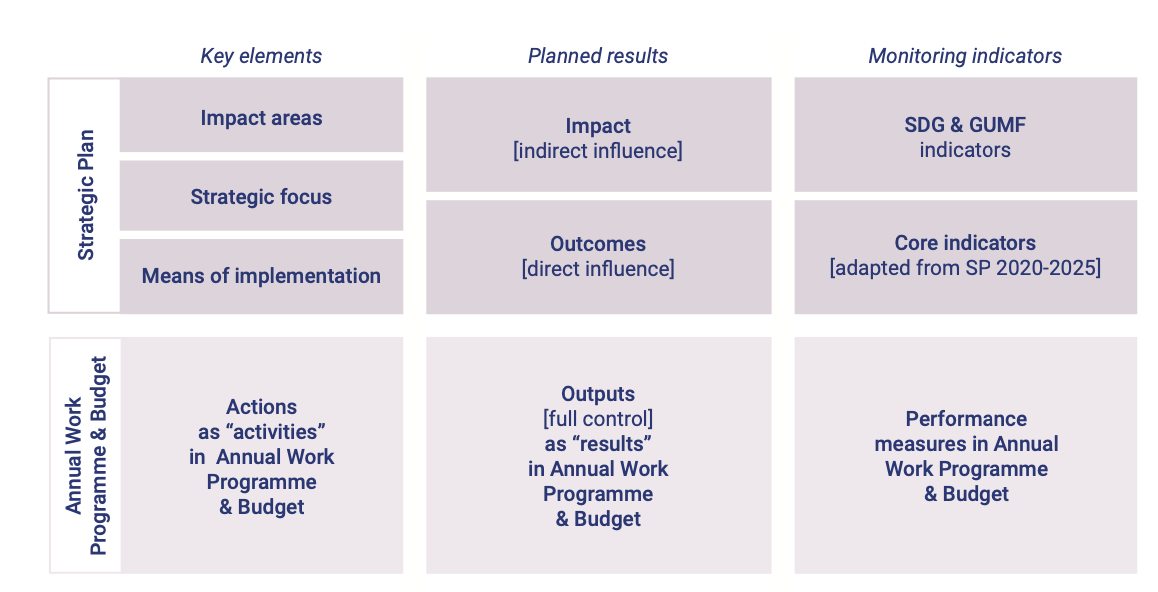
The results framework, also referred to as the results chain, explicitly defines the different levels of results expected from a specific intervention, such as a project or programme (see figure V). The following definitions apply:
- Impacts refer to the broader, long-term effects that result from an intervention, often reflecting systemic or transformative change that affects communities at large. These are the high-level, people-oriented results to which UN-Habitat will contribute;
- Outcomes are the more immediate and direct changes that arise from UN-Habitat’s actions. They are measurable in the medium term and serve as stepping stones towards achieving larger, long-term impacts. For example, outcomes could include improved urban planning practices or enhanced local capacity to address housing challenges;
- Outputs are the tangible, immediate deliverables produced by specific activities. They are within the direct control of the implementing organization and contribute to the achievement of outcomes. Outputs are referred to as “results” in the UN-Habitat annual work programme and budget.
Figure V: Key elements, planned results and monitoring indicators
Description
Impacts, outcomes and outputs form critical links in the results chain, with outputs serving as the building blocks that lead to achieving desired outcomes, which in turn contribute to broader impacts. The proposed monitoring framework for the UN-Habitat strategic plan for 2026–2029 is designed to systematically track and evaluate progress across the three levels of the plan. By aligning monitoring efforts with these results, UN-Habitat can ensure accountability, transparency and continuous improvement in delivering on its mandate.
The UN-Habitat monitoring framework will be aligned with results-based management principles, including a focus on measuring outcomes and impacts, not just activities and outputs. The framework is being designed to track and evaluate progress systematically on both levels of the plan: from the broad, transformative impacts to the more immediate outcomes influenced by UN- Habitat’s actions. This monitoring framework will be structured to ensure accountability, effectiveness and adaptability in achieving the objectives of the strategic plan.
In order to identify indicators, UN-Habitat is analysing and considering the following indicators from global frameworks, leveraging its existing monitoring frameworks and the results-based framework used for its strategic plan for the period 2020–2025:
- The Global Urban Monitoring Framework, adopted by the Statistical Commission;
- Sustainable Development Goal 11 indicators, as well as other urban-related indicators for the Goals, also linked to the Global Urban Monitoring Framework;
- Indicators for the global monitoring of the New Urban Agenda, also linked to the Global Urban Monitoring Framework.
In addition, and to align with the directions of the strategic plan for the period 2020–2025, UN-Habitat will be developing, where needed, new indicators to measure progress in relation to the strategic focus.
Indicators will be selected with attention to the following:
- Specific, measurable, attainable, relevant and time-bound principles;
- The need for a manageable scope and coverage within the strategic plan period;
- Reasonable attribution to the work and actions of UN-Habitat;
- Indicators for which data or clear pathways of data collection, data sources, data reliability and data quality assurance are available;
- Indicators for which budget resource and capacity requirements are within the capacities of the organization and implementing partners to collect and analyse data;
- Indicators which generate evidence that is verifiable and observable.
Once the set of indicators is confirmed, the corresponding baseline data, targets, sources and means of verification will be established.
Integrating quantitative and qualitative approaches in monitoring the strategic plan requires a holistic approach that balances quantitative indicators that measure progress against targets with qualitative insights that capture context, challenges and stakeholder experiences. This integration aims to ensure evidence-based decision-making while remaining responsive to complex and unplanned real- world dynamics. For this integration, the monitoring process will include a combination of indicators and storytelling.
© UN-Habitat
