Inclusive, Vibrant Neighbourhoods and Communities
Summary
Inclusive, Vibrant Neighbourhoods and Communities focuses on urban regeneration to reduce spatial inequality and poverty by transforming urban areas into connected, dynamic, diverse and vibrant neighbourhoods that incubate development for the entire city and the respective hinterland. UN-Habitat’s regeneration approach has a strong focus on human rights and increased accessibility for people with disabilities, elderly, youth, children and women, whilst opening pathways for broader socio-economic transformation.
Challenges addressed
In 75 per cent of cities globally, spatial inequality is higher today than it was 20 years ago. The majority of cities and towns have areas where multiple deprivations intersect and overlap, where socioeconomic and spatial exclusion (with higher levels of poverty, unemployment, crime, delinquency and at greater risk of environmental hazards and shocks) is higher than at city average.
The COVID-19 crisis has clearly demonstrated the importance of focusing on spatial inequality within cities. Those living in inadequate housing and working in informality are at greater risk of being exposed to pandemics and other crises due to poor living and working conditions with inadequate access to food, water, sanitation and other basic services, as well as limited livelihood opportunities. As the climate changes, increased number of extreme events, pollution and the scarcity of resources also impacts the most vulnerable and challenges social equity. To sustainably accommodate the continued urban growth, it is crucial to renew neighbourhoods and to adapt under-used spaces for new uses. Inclusive urban regeneration can help address these underlying inequalities that make particular neighbourhoods and communities vulnerable to pandemics and other urban crises.
What UN-Habitat can offer
UN-Habitat’s approach to urban regeneration encompasses a combination of different physical, environmental and socioeconomic strategies to transform urban areas into dynamic, diverse and vibrant neighbourhoods and communities and improve their connection to the wider city. Such efforts also offer the benefit of preserving cultural heritage and helping to build a sense of identity and belonging in cities.
If done right, restoration, rehabilitation, upgrading, retrofitting, conservation and revitalization, among other measures, can unlock the value of neglected assets and community resources, leveraging their potential and generating mid- and long-term investments. In partnership with local authorities, these strategies can create jobs, homes and infrastructure, paving the way towards sustainable and inclusive cities and communities that are resilient to a variety of shocks and stresses.
This Flagship Programme aims to promote urban regeneration globally by supporting governments and urban actors to build inclusive, resilient, and integrated processes. To achieve this, it offers:
- Capacity building for cities and local governments, private sector and local communities’ associations on key components for inclusive policy, governance and legislation on urban regeneration.
- A knowledge platform for urban actors in different countries to share experiences, learn from each other and pilot methodologies to advance urban regeneration globally.
- Guidance and capacity building for national and local governments to set an enabling institutional environment for urban regeneration with policies, legal and financial frameworks and inclusive governance mechanisms.
- Technical assistance, tools and methodologies for the development, implementation, and monitoring of localized policies, plans and projects, promoting integrated approaches and partnership models for urban regeneration.
- Support to multi-stakeholder partnerships for the development and implementation of successful urban regeneration processes in the long-term.
The programme contributes to the coordination of the urban dimension within United Nations Country Teams and Regional Coordination mechanisms as part of the United Nations System-Wide Strategy on Sustainable Urban Development. UN-Habitat uses its expertise and long-standing experience of working with local authorities and community structures, bringing in a new perspective. Within the United Nations system, partnerships with UNESCO, ILO, UNDP, UNEP and UNIDO will be leveraged, in particular the collaboration with UNESCO for urban regeneration in historic urban areas.
Duration of support
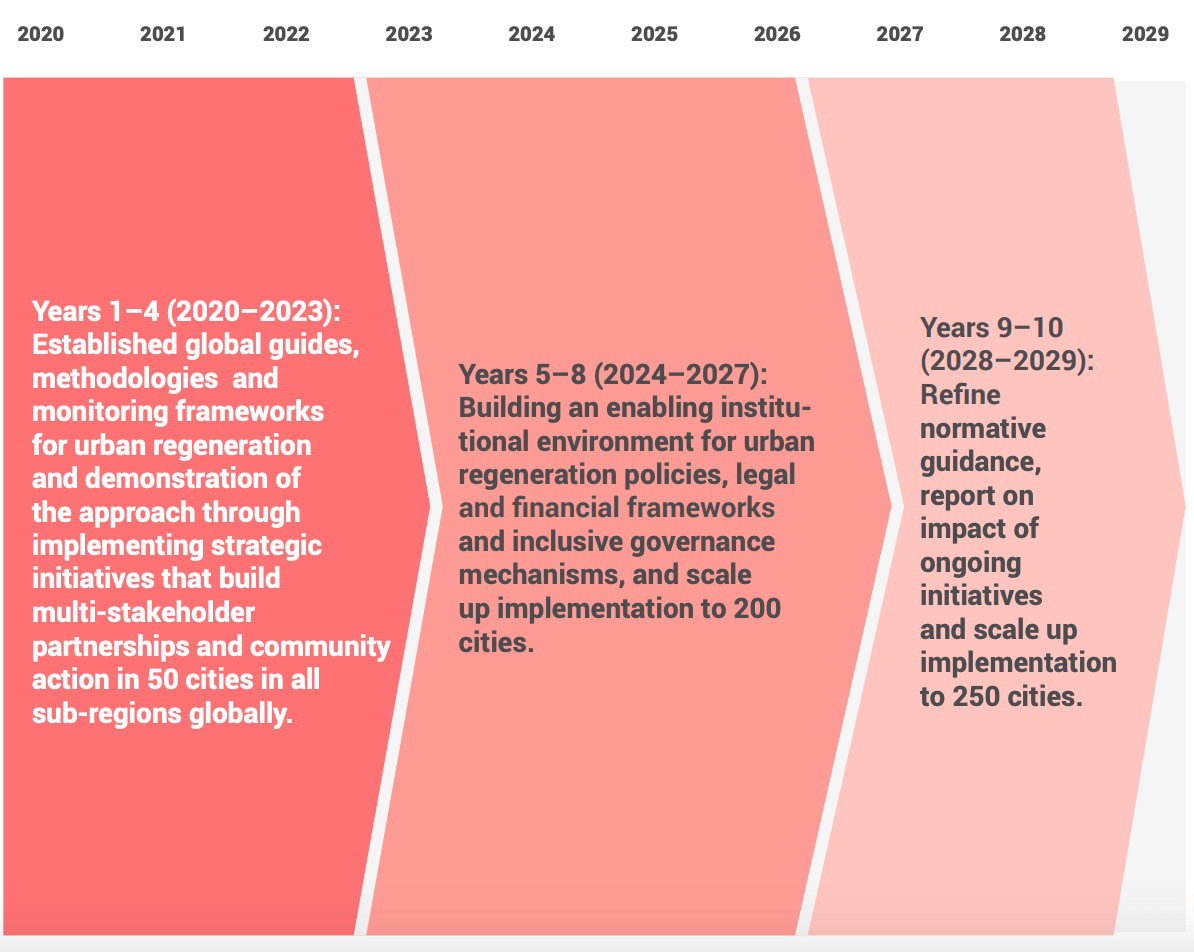
Urban regeneration requires long-term engagement. The flagship is envisioned to last until at least 2030 in three phases:
Timing and Milestones