The long climb to accessing rights in Rio de Janeiro
Description
This story is part of a series marking the 16 Days of Activism against Gender-Based Violence, exploring how housing, access to essential services and living conditions shape women's safety, dignity and rights.
Description
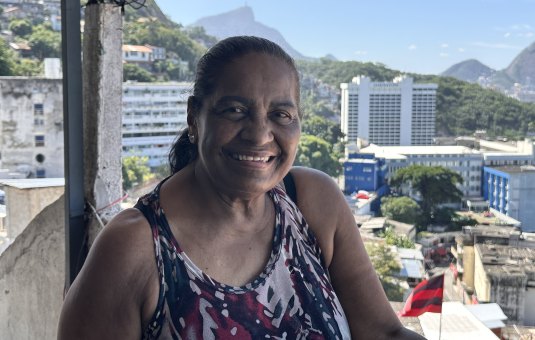
For Maria do Carmo, 65, even leaving home can be difficult.
Description with Image
She lives in Morro do Vidigal, a hillside community in Rio de Janeiro, Brazil, where steep stairs and narrow paths make getting around a challenge. She cares for her daughter and grandson, both of whom have disabilities, and rarely has the chance to leave them.
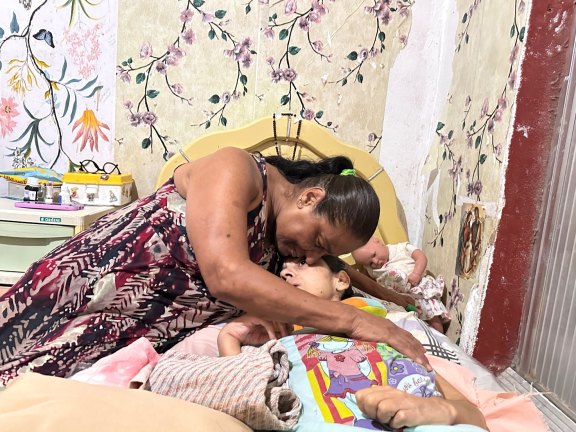
At night, Maria helps her grandson Vitor, 16, who has cerebral palsy, change position as he sleeps. Her daughter Simone, 52, who has an intellectual disability, also depends on her care. Maria looks after them both, often with little time to rest.
Maria's childhood was marked by violence. She grew up in poverty, experienced abuse as a child, and has spent much of her adult life caring for her daughter and grandson.
Maria grew up in a large family in north-eastern Brazil. Five of her 17 siblings died from hunger. When her mother left the family home in search of medical treatment in Rio de Janeiro, Maria, still a child, hid in a lorry to follow her. Unable to support her daughter, her mother left her with relatives, where Maria experienced an attempted sexual abuse. Her mother intervened and took her away.
For many girls and women, the home is not always a place of safety. Violence can take place in familiar surroundings, while poverty and dependence can make it difficult to find protection or support. Access to safe housing and services is therefore an important part of ensuring that women can exercise their rights and seek help when they need it.
Maria later settled in Vidigal, where she raised her daughter Simone. When Simone had a son, Maria took on the responsibility of raising him, too.
“I took that baby and held him right here … that’s when my love for him began,” she says.
Care that knocks on the door
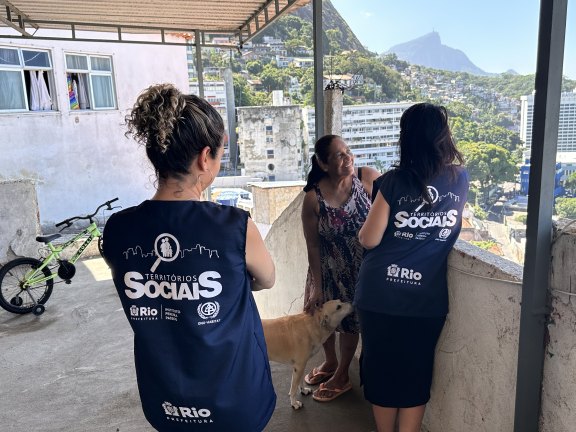
In 2024, a team from Territórios Sociais (Social Territories), a programme run by the Municipality of Rio de Janeiro in partnership with UN-Habitat, visited Maria's home. The programme works with families facing difficult living conditions, helping them access public services and support.
During the visit, the team discovered that Vitor's monthly disability benefit had been stopped. To restore it, he needed an identity document. Simone needed one, too. But taking them to a government office was difficult for Maria.
The team found another solution. Staff from the State Traffic Department came to the family's home and issued the documents. Vitor's payments could then resume. The support existed; what was missing was a way for it to reach the family.
“It is important to understand that information is crucial for these families and that, very often, vulnerability does not stem from just one dimension, such as access to income, but also from limited access to information,” says Leandro de Castro, a social worker who was part of the team.
For women carrying heavy caregiving responsibilities, living in areas with difficult access or facing limited mobility, even claiming benefits they are entitled to can become a major challenge. Bringing services to the doorstep helps remove some of those barriers.
For Maria, the payments have made a real difference. She spends much of the household's money on medication and hygiene products for her daughter and grandson.
“It helps so, so, so much,” she says.
The team also connected the family with a local organization that provides food parcels. Having food at home means one less worry for Maria.
“Not having to worry about food,” she says. “That’s already something, already a reason to be happy.”
Making support accessible
There is still more to do. Maria has also been trying to secure the disability benefit for Simone, but her application remains unresolved.
Their experience shows how difficult it can be to access support, even when people are entitled to it. For families with limited mobility, a trip to a government office can become a major obstacle. The problem is even greater in neighbourhoods where steep paths, inadequate housing and limited access to services are part of daily life.
Making cities more inclusive means ensuring that everyone, including persons with disabilities, can access the housing, services and support they need. For women facing violence, safe housing and accessible support can also be essential to seeking protection and rebuilding their lives.