A decade to deliver: Midterm review sets the course for the New Urban Agenda until 2036
Description with Image
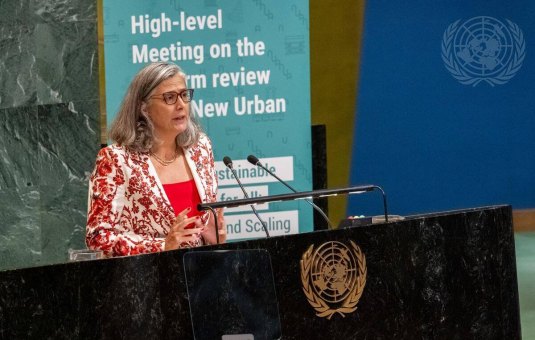
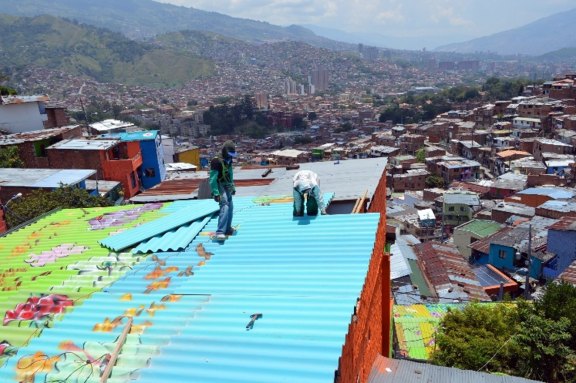
New York, 16 July 2026 – The High-level Meeting on the midterm review of the New Urban Agenda, to be held at United Nations Headquarters on 16–17 July, comes at a critical time. The world is facing a global housing crisis that is affecting more than 3 billion people, including over 1.1 billion who live in slums and informal settlements. Affordability pressures and homelessness are rising in both developed and developing countries.
Responding to these challenges and correcting the path forward will be the main task as Member States, partners and stakeholders meet to advance action on adequate housing and sustainable urbanization over the next decade, as the New Urban Agenda reaches its horizon in 2036.
Urbanization as a driver of sustainable development
The New Urban Agenda, adopted at the Habitat III Conference in 2016 and subsequently endorsed by the United Nations General Assembly, sets out a shared vision for sustainable cities and human settlements. It recognizes well-planned urbanization as a key driver of sustainable development.
The High-level Meeting marks the official midterm review of the New Urban Agenda. Over the two-day meeting, heads of state and government, ministers and other high-level representatives will review progress, identify remaining challenges and set priorities for the second half of implementation.
The review is informed by national progress reports, contributions from the United Nations system and an extensive consultative process involving Member States and a wide range of stakeholders. Ahead of the meeting, Member States have submitted 50 national reports, the majority of which are from countries in sub-Saharan Africa and the regions of Northern Africa and Western Asia.
The meeting will conclude with the adoption of a concise, action-oriented political declaration that renews global commitment to implementing the New Urban Agenda through 2036.New York, 16 July 2026 – The High-level Meeting on the midterm review of the New Urban Agenda, to be held at United Nations Headquarters on 16–17 July, comes at a critical time. The world is facing a global housing crisis that is affecting more than 3 billion people, including over 1.1 billion who live in slums and informal settlements. Affordability pressures and homelessness are rising in both developed and developing countries.
Responding to these challenges and correcting the path forward will be the main task as Member States, partners and stakeholders meet to advance action on adequate housing and sustainable urbanization over the next decade, as the New Urban Agenda reaches its horizon in 2036.
Urbanization as a driver of sustainable development
The New Urban Agenda, adopted at the Habitat III Conference in 2016 and subsequently endorsed by the United Nations General Assembly, sets out a shared vision for sustainable cities and human settlements. It recognizes well-planned urbanization as a key driver of sustainable development.
The High-level Meeting marks the official midterm review of the New Urban Agenda. Over the two-day meeting, heads of state and government, ministers and other high-level representatives will review progress, identify remaining challenges and set priorities for the second half of implementation.
The review is informed by national progress reports, contributions from the United Nations system and an extensive consultative process involving Member States and a wide range of stakeholders. Ahead of the meeting, Member States have submitted 50 national reports, the majority of which are from countries in sub-Saharan Africa and the regions of Northern Africa and Western Asia.
The meeting will conclude with the adoption of a concise, action-oriented political declaration that renews global commitment to implementing the New Urban Agenda through 2036.
Description
Key outcomes of the midterm review
The meeting is anchored in the Secretary-General's 2026 quadrennial report on the implementation of the New Urban Agenda. The report serves as the official midterm review and reflects the voluntary inputs from Member States.
The 2026 report finds that progress has been observed in several areas since 2016. These advances include expanded access to transport and basic services, the growing integration of urban priorities in climate policy, and the use of voluntary local reviews as tools for SDG localization.
Despite these advances, implementation has remained uneven and insufficient. For instance, public transportation has reached more than 60 per cent of the global urban population, yet access remains at only 37 per cent in least developed countries and 34 per cent in sub-Saharan Africa. Local and regional governments remain on the front line of service delivery, urban planning, climate action and crisis response, but their mandates are often not matched by adequate finance, capacity or authority.
Based on these findings, the report recommends key actions to further accelerate implementation of the New Urban Agenda. These include placing well-planned and well-managed urbanization at the centre of national development strategies. The report also recommends adopting integrated housing policies that prioritize low-income and vulnerable groups to progressively realize the human right to adequate housing. It also urges Member States to strengthen coordinated and sustained responses to homelessness as it becomes a growing global development challenge across all regions.
These challenges and recommendations reinforce the report's position that adequate housing, transformative action in slums and informal settlements, and homelessness prevention are powerful accelerators of sustainable development. They have multiplier effects across poverty eradication, health, climate resilience, economic opportunity and social inclusion.
Reaffirming commitments
The Political Declaration to be adopted at the High-Level Meeting is expected to reaffirm the New Urban Agenda's alignment with the 2030 Agenda for Sustainable Development, the Pact for the Future, the Paris Agreement, the Sendai Framework and other global frameworks. It will also renew support for UN-Habitat as the United Nations focal point for sustainable urban development and implementation of the New Urban Agenda.
The High-level Meeting is also expected to build on the outcomes of the Ministerial Meeting on the New Urban Agenda and the Baku Call to Action adopted at the thirteenth session of the World Urban Forum (WUF13) in Baku. It will draw on the momentum generated by WUF13, which brought together more than 58,000 participants from 176 countries, to help shape priorities for the decade ahead.
With ten years left to deliver, the midpoint review is more than a milestone. It is an opportunity to determine whether the next decade will fulfil the promise of the New Urban Agenda: more inclusive, prosperous, resilient and sustainable cities for all.
The High-level Meeting will be livestreamed on UN Web TV.